Gyro (Γύρος)

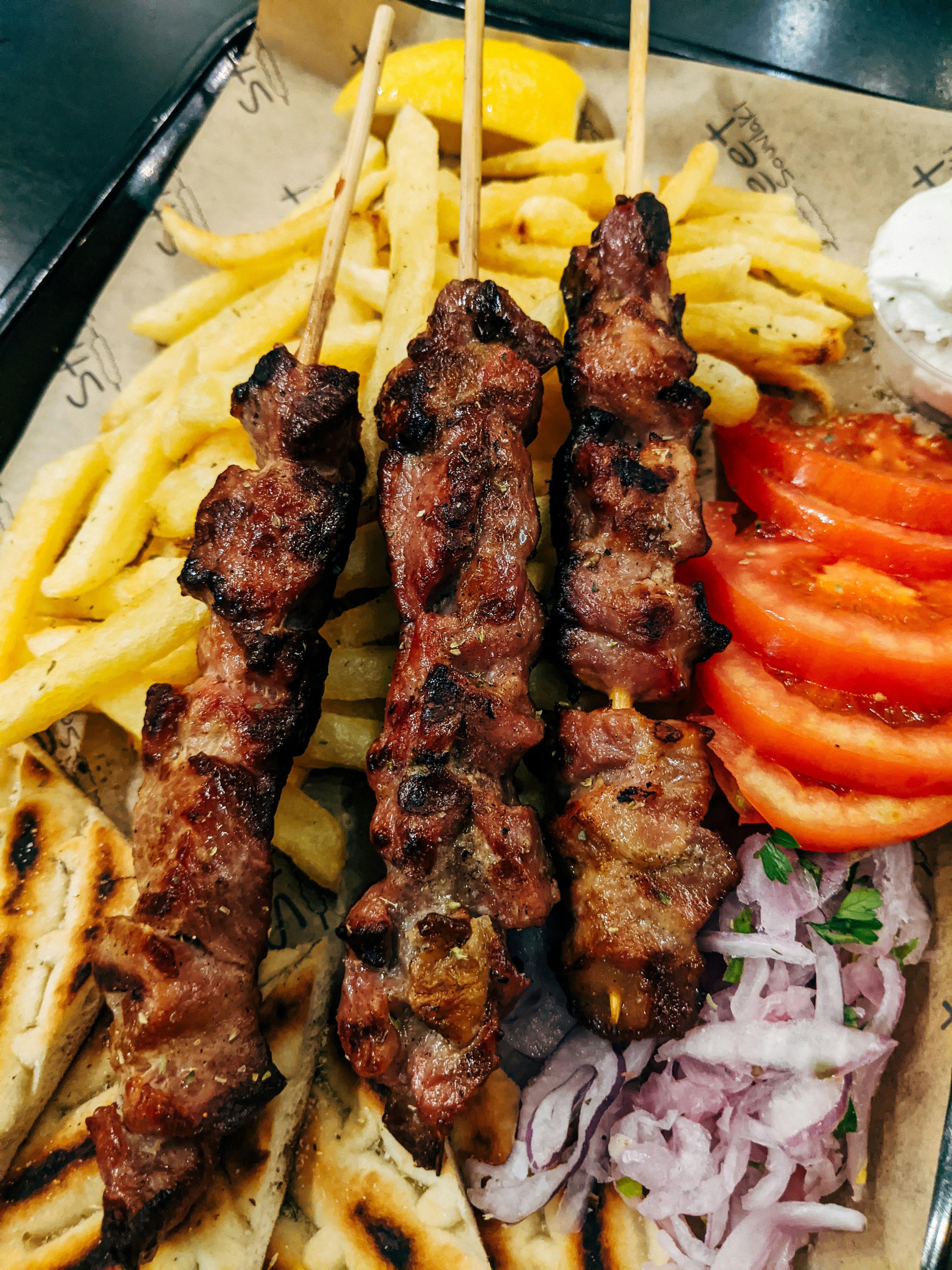
Gyro and souvlaki are often confused, but gyro meat is stacked and shaved off a spinning vertical rotisserie, while souvlaki is small cubes threaded on a skewer — two different grilling techniques that both ended up wrapped in the same pita.
Thin slices of seasoned pork or chicken are shaved straight off a slow-turning vertical rotisserie, then piled into warm pita with tomato, onion, tzatziki and fries. Grill stands across Athens sell it wrapped in paper for eating on the move.
What is Gyro?
A gyro (Greek: γύρος, from the word for a turn or circle, said YEE-ros) is meat stacked on a tall vertical spit, roasted slowly as it turns, and shaved off in thin slices. In Greece it is usually pork, sometimes chicken, and it is wrapped in a thick, soft pita with tzatziki, tomato, raw onion and, very often, a handful of chips tucked inside. Grill stands sell it wrapped in paper to eat on the move.
The vertical spit is generally linked to the doner kebab of Anatolia and the wider Middle East, and gyro became a cheap grab-and-go food in Athens and other Greek cities from around the mid-twentieth century. Gyro is often confused with souvlaki, but they are different things: gyro is shaved from the spit, while souvlaki is small pieces of meat grilled on a skewer. To add to the confusion, in Athens and much of southern Greece the word souvlaki is also used for the wrapped sandwich whichever meat is inside, including gyro, while skewered meat sold without bread is often called kalamaki there.
How to make gyro-style pork at home (without a spit)
Ingredients
- For the pork: 1 kg boneless pork shoulder (neck), well marbled, 4 garlic cloves, crushed, 3 tablespoons olive oil, 3 tablespoons lemon juice, 2 teaspoons dried oregano, 1 teaspoon dried thyme, 2 teaspoons sweet paprika, ½ teaspoon ground cumin, 1 teaspoon black pepper, 2½ teaspoons fine salt (about 15 g), 2 tablespoons oil for frying
- For the tzatziki: 300 g thick Greek yoghurt, ½ cucumber (about 200 g), 2 garlic cloves, crushed, 1 tablespoon olive oil, 1 teaspoon red wine vinegar or lemon juice, 1 tablespoon chopped dill (optional), ½ teaspoon salt
- For the chips: 700 g potatoes, 2 tablespoons oil, 1 teaspoon salt
- To serve: 6 thick pita breads (Greek-style pitta, shop-bought is fine), 3 medium tomatoes, sliced, 1 red onion, thinly sliced, paprika for sprinkling (optional)
Method
- Slice the pork across the grain into pieces about 1 cm thick and 5 cm wide. Mix the garlic, olive oil, lemon juice, oregano, thyme, paprika, cumin, pepper and salt, rub it into the meat, cover and marinate in the fridge for at least 4 hours or overnight.
- Heat the oven to 160 °C (140 °C fan, gas 3). Pack the slices tightly, in overlapping layers, into a 900 g (2 lb) loaf tin about 23 × 13 cm, pressing down so there are no gaps. Cover the tin tightly with foil and roast for 2½ hours.
- Uncover and roast for another 20 minutes. The pork is safe once the centre reaches 63 °C, but shoulder only turns tender and sliceable at around 90 °C, so check the centre with a thermometer and give it more time if it is below that. Pour off the fat and juices, let the pork rest in the tin for 15 minutes, then turn it out. If it is too soft to slice neatly, chill it for an hour first.
- While the pork cooks, make the tzatziki. Grate the cucumber, mix it with a pinch of the salt, leave for 10 minutes, then squeeze out as much liquid as you can with your hands. Stir it into the yoghurt with the garlic, olive oil, vinegar, dill and the rest of the salt. Chill for at least 30 minutes so the garlic mellows.
- Make the chips: raise the oven to 220 °C (200 °C fan, gas 7) once the pork is out. Cut the potatoes into 1 cm sticks, rinse and dry them very well, toss with the oil and salt and spread over a baking tray in a single layer. Roast for 30–35 minutes, turning once, until golden and crisp.
- Slice the rested pork thinly, about 3–4 mm. Heat 1 tablespoon of the oil in a large frying pan, adding a little more for each batch, over high heat and fry the slices in batches for 2–3 minutes, until the edges are browned and crisp.
- Warm each pita in a dry pan or under the grill. Spread with tzatziki, add tomato, onion, a good pile of meat and a few chips, add a little more tzatziki, then fold in the sides and roll up in a square of baking paper or foil so it can be eaten in hand.
Tips
- This is an approximation. A real gyro cooks as thin layers of meat and fat on a spit, with the outside constantly roasting and being shaved off; layering marinated shoulder in a tin and crisping the slices in a pan gives a similar texture and flavour, but not the same thing.
- Use shoulder or neck, not loin. The fat keeps the meat moist through the long roast and gives the crisp edges once it is fried.
- Squeeze the grated cucumber properly. Wet cucumber is the usual reason tzatziki goes thin and watery.
- Fry the slices in batches. A crowded pan steams the meat instead of crisping it.
- Keep cooked pork in the fridge and use within 3 days, and reheat it until piping hot.
Regional versions
- Chicken gyro: use 1 kg boneless, skinless chicken thighs with the same marinade, packed into the tin and roasted covered at 190 °C (170 °C fan) for 50–60 minutes until the centre reaches 75 °C, then sliced and fried as above.
- In Greece gyro is traditionally made with pork or chicken. Lamb and beef spit-roasted meat is more typical of doner and shawarma shops elsewhere.
- Many stands add a sprinkle of paprika or a little ketchup or mustard, and some leave out the chips; chips inside are very common in Greece but not universal.
- Served on a plate rather than wrapped, it comes with the same sides and is a gyro plate (in Greek, a portion, merida).
Questions
What is the difference between gyro and souvlaki?
Gyro is meat stacked on a vertical spit, roasted and shaved into thin slices. Souvlaki is small pieces of meat grilled on a skewer. Both are commonly served in pita, and in Athens and parts of southern Greece souvlaki is used as a general name for the wrapped sandwich, including one filled with gyro.
What is gyro meat made of?
In Greece it is usually pork, or chicken. Slices of seasoned meat and fat are stacked on the spit. Outside Greece the term is often used for a lamb and beef version, which is closer to doner kebab.
How do you pronounce gyro?
In Greek it is closer to YEE-ros. In English-speaking countries it is also commonly said JY-roh or YEER-oh.
Can you make gyro without a spit?
Yes, but it is an approximation. Roasting layered, marinated pork shoulder in a tin and then crisping thin slices in a hot pan gives a similar texture and flavour.
More from Greece
 Souvlaki (Σουβλάκι)
 Koulouri (Κουλούρι)
 Loukoumades
 Spanakopita (Σπανακόπιτα)
 Retsina (Ρετσίνα)
 Kokoretsi