Laksa
In the 1990s and 2000s, stalls along Katong's East Coast Road fought a so-called 'laksa war', each claiming to be the original Katong laksa.
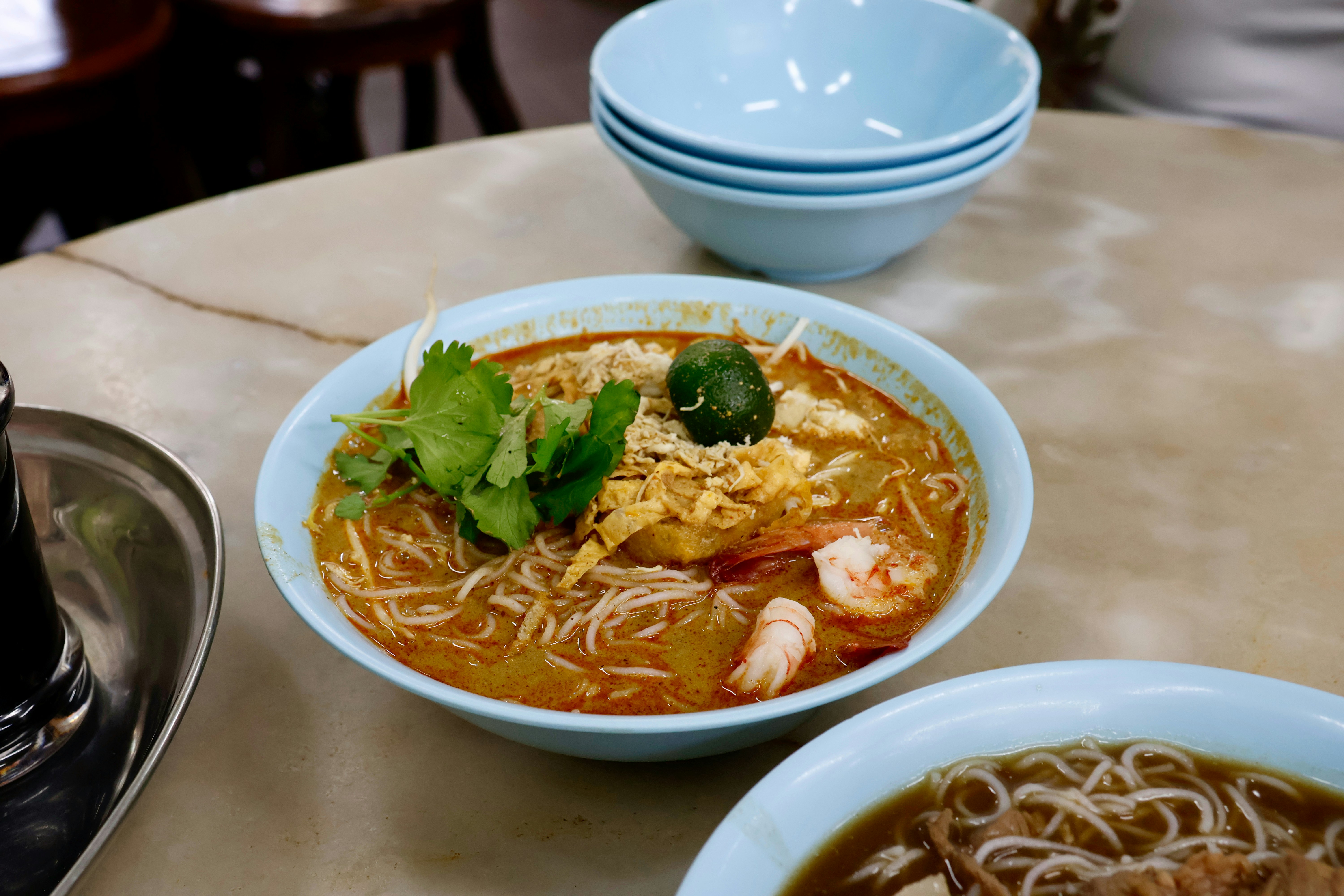
Rice vermicelli sits in a spiced coconut curry broth loaded with prawns, fish cake, and tofu puffs, topped with laksa leaf and sambal. In Singapore's Katong style, the noodles are cut short so the whole bowl can be eaten with just a spoon.
What is Laksa?
Singapore laksa, often called Katong laksa after the district on the east side of the island, is a bowl of rice vermicelli in a rich, spicy coconut curry broth, topped with prawns, fish cake, tofu puffs, bean sprouts, sambal and laksa leaf (Vietnamese coriander). In the Katong style, the noodles are cut short so the whole bowl can be eaten with just a spoon.
Laksa is commonly linked to Peranakan cooking, the blend of Chinese and Malay cooking that developed among the Straits Chinese communities. Katong is often named as the home of this version, and stalls there are known to compete over the claim to the original, but the exact origins are debated. The flavour comes from a fresh spice paste (rempah) fried slowly in oil, with dried shrimp and shrimp paste giving the broth its savoury depth.
How to make Singapore (Katong) laksa
Ingredients
- For the rempah: 8 dried red chillies, soaked in hot water for 15 minutes and deseeded, 6 shallots (about 150 g), 3 garlic cloves, 3 stalks lemongrass (white part only, sliced), 3 cm galangal, 2 cm fresh turmeric (or 1 teaspoon ground), 4 candlenuts (or macadamia nuts), 2 teaspoons shrimp paste (belacan), toasted, 30 g dried shrimp, soaked in warm water for 15 minutes and drained
- 4 tablespoons neutral oil
- 400 ml (1 can) coconut milk
- 800 ml chicken stock or prawn stock (made by simmering the prawn shells and heads in stock for 15 minutes and straining)
- 1 tablespoon fish sauce, 1 teaspoon sugar, about 1 teaspoon salt, to taste
- 12 large raw prawns (about 300 g), peeled and deveined, with the shells kept if making the stock
- 250 g dried thick rice vermicelli (bee hoon)
- 8 slices fish cake, 8 fried tofu puffs, halved, 100 g bean sprouts, 2 hard-boiled eggs, halved
- To serve: a handful of laksa leaf (Vietnamese coriander), chilli sambal (shop-bought is fine), lime wedges
Method
- Toast the shrimp paste in a dry pan for about 1 minute, until fragrant, or wrap it in foil and warm it. Blend the rempah ingredients with 3 to 4 tablespoons of water into a fine paste. Candlenuts should always be cooked, never eaten raw.
- Heat the oil in a large pot over medium-low heat, add the rempah and fry gently for 10 to 12 minutes, stirring often, until the oil separates and the paste smells cooked and deeply aromatic. Add a splash of water if it begins to stick.
- If you kept the prawn shells and heads, simmer them in the stock for 15 minutes, then strain and discard them. Add the stock to the rempah, bring to a simmer and cook for 15 minutes. Stir in the coconut milk, fish sauce, sugar and salt and heat gently until almost simmering; do not boil hard once the coconut milk is in, as it can split. Taste and adjust.
- Cook the vermicelli in boiling water according to the packet (usually 4 to 6 minutes) until tender. Hard-boil the eggs for 9 minutes, cool, peel and halve them. Drain the noodles and cut into short lengths with scissors. Blanch the bean sprouts and fish cake in boiling water for 30 seconds.
- Add the prawns to the simmering broth for 2 to 3 minutes until pink and opaque all the way through, and then remove from the heat. Warm the tofu puffs in the broth for the last minute so they soak up the soup.
- Divide the noodles between 4 bowls with the bean sprouts and fish cake. Ladle over the hot broth, then top with prawns, tofu puffs, egg, torn laksa leaf and a spoonful of sambal. Serve with lime.
Tips
- Be patient with the rempah. Raw-tasting paste is the usual cause of a flat laksa; it is ready when the oil visibly separates.
- Make the stock from the prawn shells and heads for a much deeper broth.
- The broth keeps well in the fridge for 2 days (without the noodles), but reheat it gently without a hard boil, and make sure it is steaming hot all the way through before serving.
- Laksa leaf is hard to find outside Asian shops; fresh coriander plus a little mint is a rough substitute, but the flavour is different.
Regional versions
- Katong laksa is traditionally served with cockles, which can be added to the bowl at the end or left out.
- Penang (asam) laksa is a different dish: a sour, fish-based broth with tamarind and no coconut milk.
- A simple shortcut is a ready-made laksa paste, fried the same way, though the flavour is less complex.
- For a vegetarian version, leave out the dried shrimp, shrimp paste and fish sauce, use vegetable stock and add soy sauce and fried tofu.
Questions
What is the difference between laksa and Katong laksa?
Laksa is a family of spicy noodle soups across Southeast Asia. Katong laksa is the Singapore version: a coconut curry broth with rice vermicelli cut short so it can be eaten with a spoon.
Is laksa very spicy?
It can be, but the heat is adjustable: use fewer dried chillies in the rempah and add sambal at the table to taste.
What can I use instead of laksa leaf?
Laksa leaf (Vietnamese coriander) has a distinctive flavour. Fresh coriander with a little mint is a rough substitute.
Can I make laksa ahead?
Yes. The broth keeps in the fridge for 2 days without the noodles. Reheat it gently until piping hot, and cook the prawns and noodles fresh.