Stroopwafel
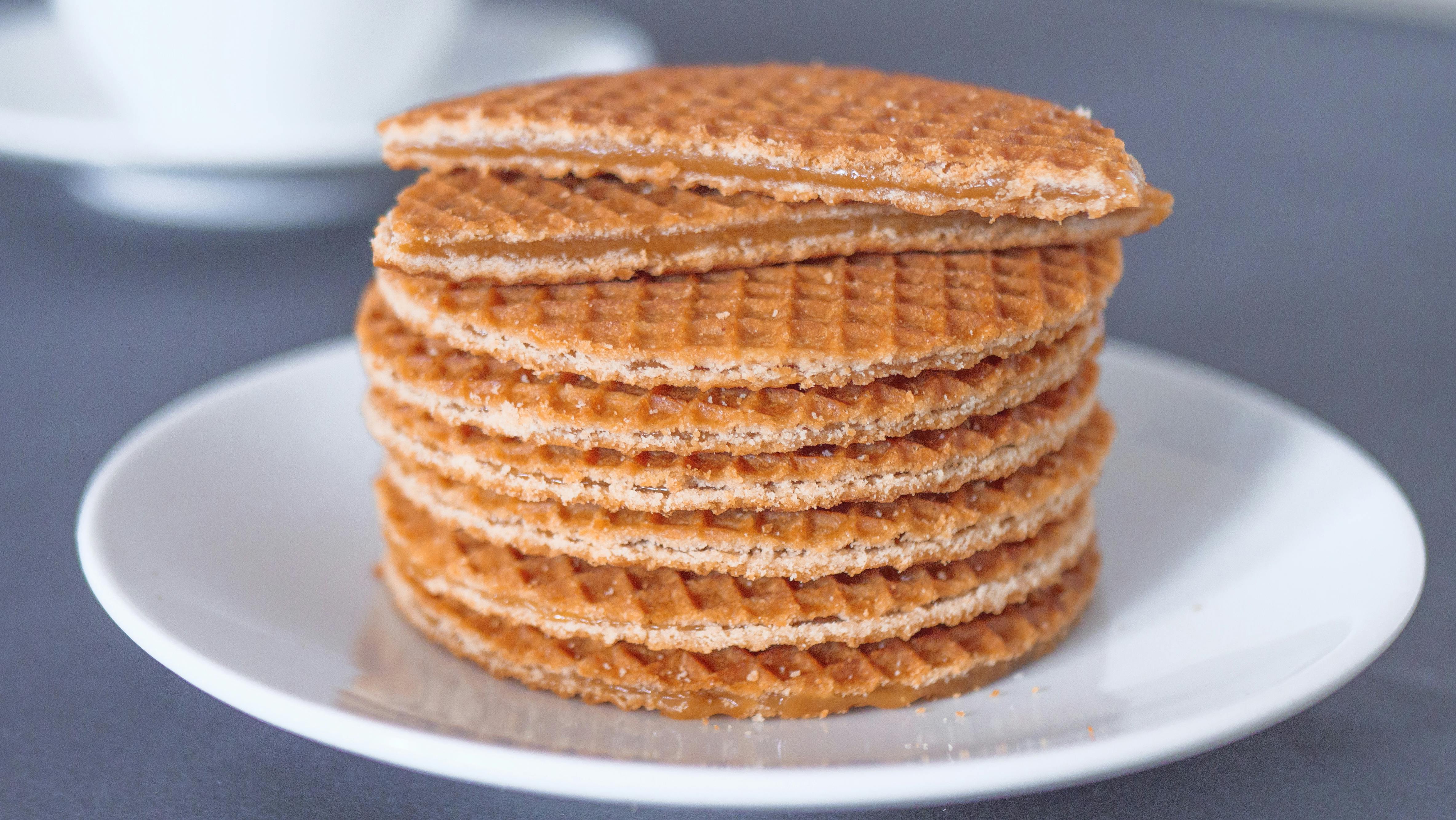
Gouda still claims the stroopwafel as its own, and 'Goudse stroopwafels' are sold there as the town's signature treat alongside its cheese.
A stroopwafel is two thin waffle cookies pressed together around a caramel-syrup filling. At markets, vendors griddle them to order and sell them still warm and soft, gooier than the packaged ones sold in supermarkets.
What is Stroopwafel?
A stroopwafel is two thin, crisp waffle wafers stuck together with a layer of soft caramel syrup. At Dutch markets they are made to order on a hot iron, split, filled and sold warm, so the syrup is gooey rather than set. A common habit is to rest one on top of a hot cup of coffee or tea so the syrup softens.
It is usually traced to Gouda, in the Netherlands, in the late 18th or early 19th century, and is often said to have begun as a cheap way for bakers to use up scraps and crumbs. Gouda still claims it as a local speciality.
How to make stroopwafels
Ingredients
- For the wafers: 250 g plain flour (about 2 cups), 75 g light brown sugar (about ⅓ cup, packed), 125 g softened butter, 1 egg, 7 g instant yeast (1 sachet, about 2¼ teaspoons), 50 ml lukewarm milk, ½ teaspoon ground cinnamon, ¼ teaspoon salt
- For the filling: 60 g butter, 100 g dark brown sugar, 60 g golden syrup (or Dutch stroop, if you can find it), ½ teaspoon ground cinnamon, a pinch of salt
- Equipment: a stroopwafel, pizzelle or other thin flat wafer iron (about 9-10 cm), a round cutter of about 8-9 cm, a thin sharp knife
Method
- Mix the flour, sugar, yeast, cinnamon and salt. Rub in the softened butter, then add the egg and warm milk and knead for about 5 minutes into a smooth, fairly stiff dough. It will feel quite buttery. Cover and leave in a warm place for 45-60 minutes until noticeably puffier (it will not double).
- Divide into 16 balls of about 35 g each. Cover and keep them covered while you cook.
- Heat the iron. Place a ball in the centre, close the lid and press for about 30-60 seconds (follow your iron's guidance) until golden brown. Lift out and, while still hot and flexible, immediately press the cutter through the wafer to trim it into a neat round. Cook the rest the same way and let the wafers cool on a rack; they crisp as they cool.
- Make the filling: melt the butter, sugar, golden syrup, cinnamon and salt in a small pan, stirring, and simmer gently for 3-5 minutes until thick and glossy. If you have a thermometer, aim for about 105-110 °C; much hotter and the filling sets hard when cool. Keep it warm; hot sugar syrup causes bad burns, so keep children away and take care.
- Use two wafers per stroopwafel (8 in total): spread about 1 tablespoon of the warm filling on one, then press the other on top. If your iron makes thicker wafers, you can instead split each wafer in half while still hot, using a thin knife along the edge, which gives up to 16 thinner stroopwafels; use about 2 teaspoons of filling for each. Work quickly: the filling thickens as it cools; if it does, warm it gently for a minute.
- Let them set for about 10 minutes. Eat the same day for the best texture, or keep in an airtight tin for up to a week.
Tips
- Do not skip the iron. A normal deep waffle maker makes thick waffles, not thin wafers, and the cookie will not work. A pizzelle or krumkake iron is a good substitute; a proper stroopwafel iron is best.
- If you have no iron, the closest you can get is rolling the dough to 2-3 mm, cutting rounds and baking them at 180 °C for about 8-10 minutes (watch them from 8 minutes) until golden. You will get a crisp filled biscuit that is tasty but is not really a stroopwafel.
- Pizzelle irons make wafers that are thinner and a little smaller than market stroopwafels, so use smaller balls of about 20-25 g and expect more than 16 wafers.
- If the filling is too runny, simmer it for another minute; if too hard, stir in a spoonful of water or cream and reheat gently.
- Trim (and split, if you are splitting) the wafers while hot; once cool they are too brittle to cut.
Regional versions
- Dutch stroop (a dark treacle-like cane syrup) gives the authentic flavour if you can find it; golden syrup is the easy alternative.
- Dipping one half in melted chocolate is a modern addition.
- Vendors sometimes add a pinch of nutmeg or a drop of vanilla to the filling.
- Mini stroopwafels are made with smaller balls and a smaller cutter.
Questions
What is a stroopwafel?
Two thin waffle-style wafers sandwiched with a caramel-syrup filling, a speciality of the Netherlands.
How do you eat a stroopwafel?
Place it on top of a hot cup of coffee or tea for a minute or two so the steam warms and softens the syrup, then eat it.
Can I make stroopwafels without an iron?
Not properly. A pizzelle or krumkake iron works. Without any iron you can bake thin rounds in the oven and sandwich them with syrup, but the result is a biscuit, not a stroopwafel.
Where are stroopwafels from?
The Netherlands. They are usually traced to Gouda, sometime around the late 18th or early 19th century.