Portugal Street Food
Portuguese street food is unfussy and fast — a warm custard tart from the bakery window, a pork sandwich from the kiosk counter.
🥧 Lisbon's iconic custard tart began as a way for monks to use up egg yolks left over from starching their robes with egg whites.
31 street food dishes from Portugal, across 7 regions — what each one is, why it's made that way, and what to expect when you order it.
Signature street foods of Portugal
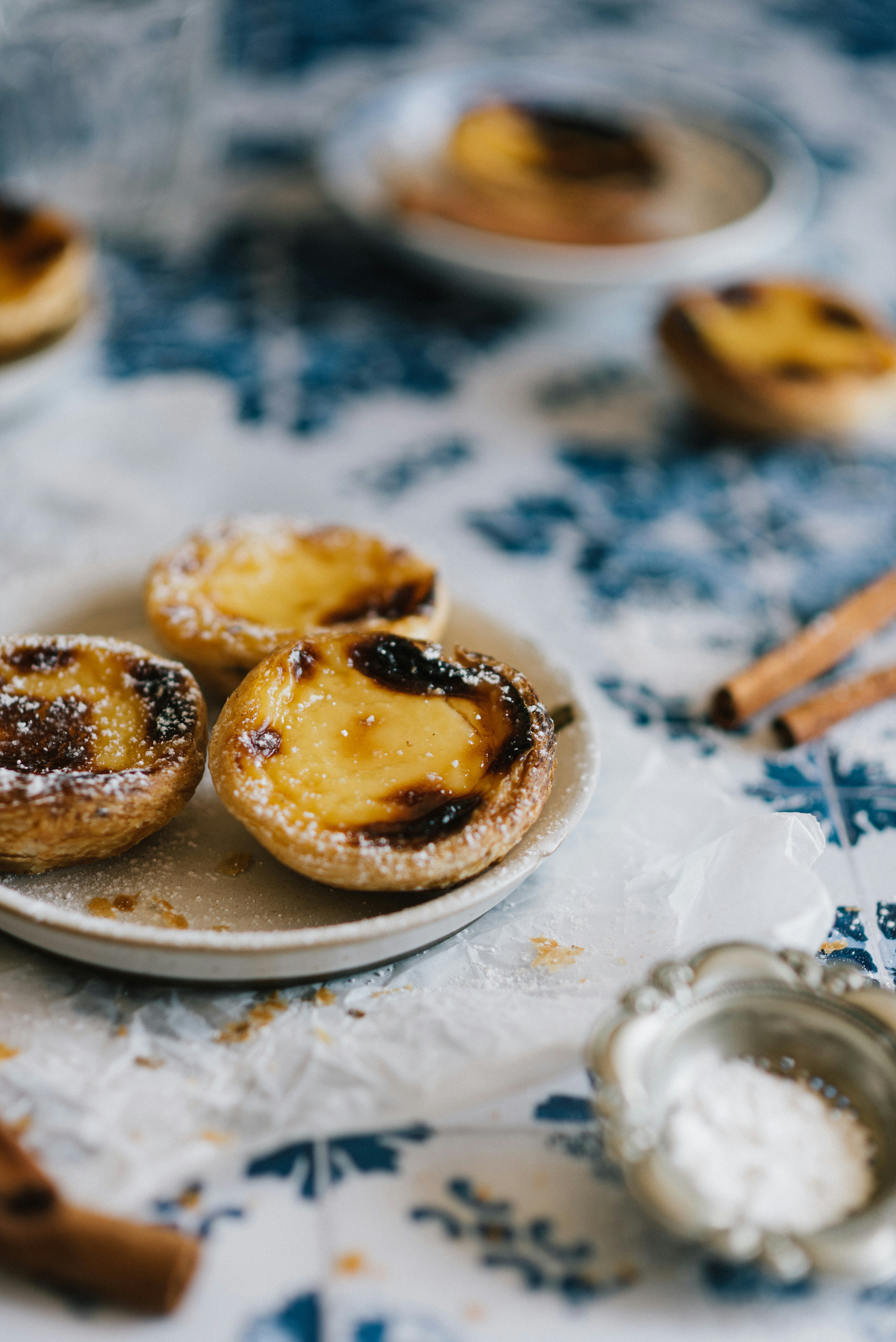 Bakery Window · Custard Tart
Pastel de Nata
The original recipe is still baked from a version kept secret by one Lisbon bakery, descended directly from the monks who invented it.
A pastel de nata is a small custard tart in flaky, crisp pastry, baked until the top is blistered and caramelized, then dusted with cinnamon and powdered sugar. It's sold warm from bakery…
Bakery Window · Custard Tart
Pastel de Nata
The original recipe is still baked from a version kept secret by one Lisbon bakery, descended directly from the monks who invented it.
A pastel de nata is a small custard tart in flaky, crisp pastry, baked until the top is blistered and caramelized, then dusted with cinnamon and powdered sugar. It's sold warm from bakery…
 Kiosk Sandwich · Marinated Pork
Bifana
It's just thin, wine-and-garlic-simmered pork in a plain bread roll — no lettuce, no cheese, sometimes not even a sauce — and that bare-bones…
A bifana is thin pork slices, marinated and simmered in garlic and wine, packed into a plain white bread roll — sometimes with a smear of mustard, rarely anything more. It's sold from…
Kiosk Sandwich · Marinated Pork
Bifana
It's just thin, wine-and-garlic-simmered pork in a plain bread roll — no lettuce, no cheese, sometimes not even a sauce — and that bare-bones…
A bifana is thin pork slices, marinated and simmered in garlic and wine, packed into a plain white bread roll — sometimes with a smear of mustard, rarely anything more. It's sold from…
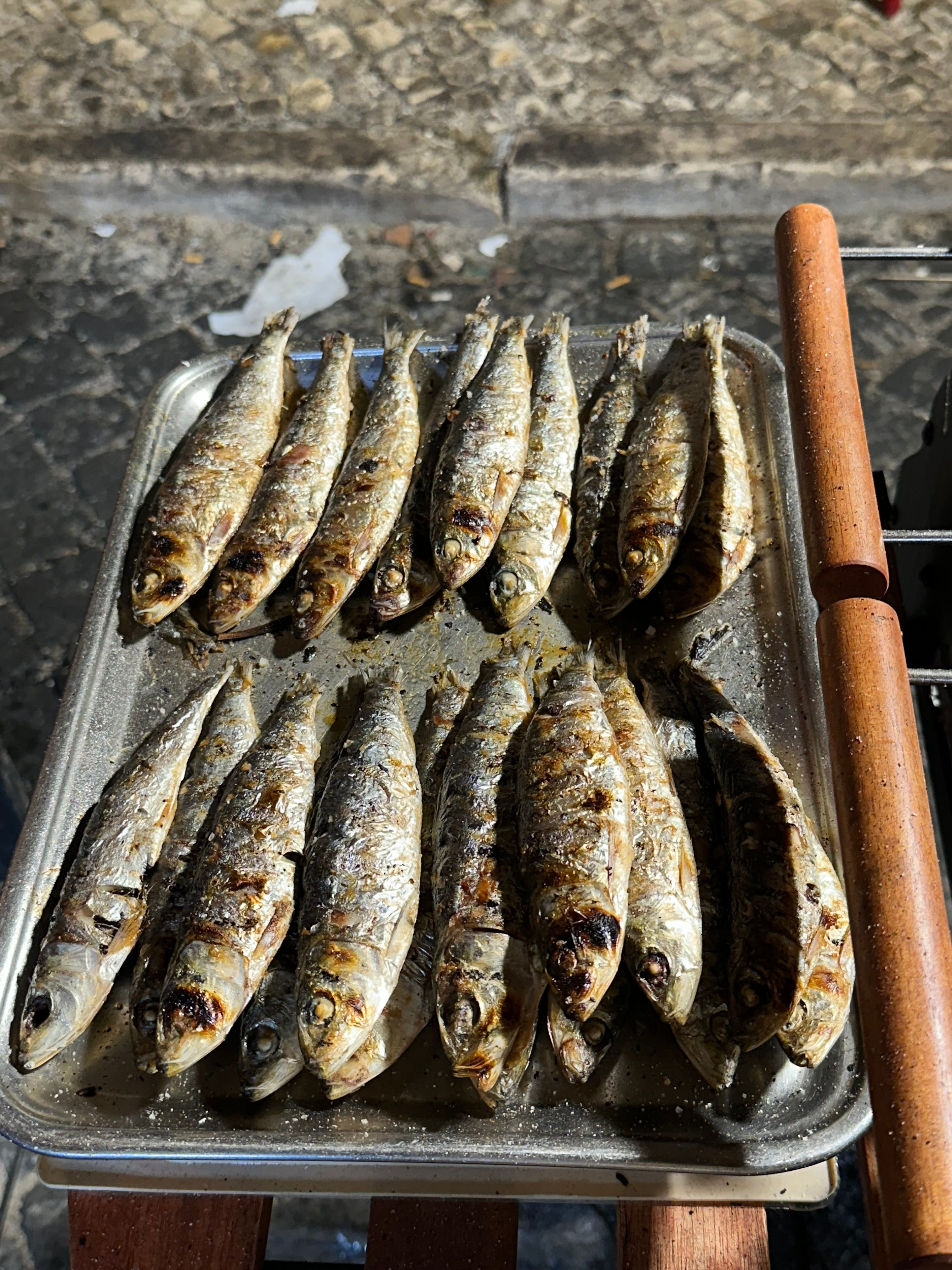 Grilled · Summer Festival Food
Sardinhas Assadas (Grilled Sardines)
During Lisbon's June festas, the whole city smells of charcoal-grilled sardines — the fish even shows up printed on festival banners and souvenirs.
Whole fresh sardines are salted and grilled over charcoal until the skin blisters, then served simply with boiled potatoes, roasted peppers, and bread — often eaten right off the tray…
Grilled · Summer Festival Food
Sardinhas Assadas (Grilled Sardines)
During Lisbon's June festas, the whole city smells of charcoal-grilled sardines — the fish even shows up printed on festival banners and souvenirs.
Whole fresh sardines are salted and grilled over charcoal until the skin blisters, then served simply with boiled potatoes, roasted peppers, and bread — often eaten right off the tray…
 Market Cauldron · Green Soup
Caldo Verde
The collard greens for caldo verde are traditionally sliced so thin they're almost translucent — a knife skill cooks train for years to master.
Caldo verde is a simple soup of pureed potato and onion broth threaded with ribbon-thin strips of collard greens (couve galega) and a slice of smoky chouriço, finished with a drizzle of…
Market Cauldron · Green Soup
Caldo Verde
The collard greens for caldo verde are traditionally sliced so thin they're almost translucent — a knife skill cooks train for years to master.
Caldo verde is a simple soup of pureed potato and onion broth threaded with ribbon-thin strips of collard greens (couve galega) and a slice of smoky chouriço, finished with a drizzle of…
Street food by region
7 regions of Portugal with their own dishes.
Norte street food
🍷
Douro Valley · Fortified Wine
Port Wine
The Douro Valley became one of the world's first legally demarcated wine regions in 1756 — specifically to stop fraudsters from selling fake Port.
Port is a fortified wine made from grapes grown along the steep terraces of the Douro Valley, then aged and shipped from cellars across the river in Vila Nova de Gaia. It's sipped as a…
🥪
Café Counter · Beer-Sauce Sandwich
Francesinha
Its name means 'little Frenchie' — it began as a Porto cook's attempt to reinvent the French croque-monsieur using local sausage and a beer-spiked…
Layers of steak, smoked sausage and ham are stacked between toasted bread, blanketed in melted cheese, and drowned in a hot tomato-and-beer sauce, usually with a fried egg on top and fries…
 Tavern Stew · Tripe & Beans
Tripas à Moda do Porto
Porto residents are nicknamed 'tripeiros' — tripe-eaters — because of this dish, a badge of civic pride rather than an insult.
White beans, tripe and assorted pork cuts are stewed slowly with carrots, cumin and paprika into a thick pot, traditionally served with rice. Long a fixture of Porto's tascas and market…
Tavern Stew · Tripe & Beans
Tripas à Moda do Porto
Porto residents are nicknamed 'tripeiros' — tripe-eaters — because of this dish, a badge of civic pride rather than an insult.
White beans, tripe and assorted pork cuts are stewed slowly with carrots, cumin and paprika into a thick pot, traditionally served with rice. Long a fixture of Porto's tascas and market…
 Market Stall · Fried Pork
Rojões à Moda do Minho
Traditional Minho versions serve the fried pork alongside blood-and-flour cakes called papas de sarrabulho — nothing from the pig goes to waste.
Bite-sized cubes of pork are marinated in wine, garlic and bay leaf, then fried in lard until deeply browned and crisp-edged, served with roasted chestnuts, potatoes or cornbread. A winter…
Market Stall · Fried Pork
Rojões à Moda do Minho
Traditional Minho versions serve the fried pork alongside blood-and-flour cakes called papas de sarrabulho — nothing from the pig goes to waste.
Bite-sized cubes of pork are marinated in wine, garlic and bay leaf, then fried in lard until deeply browned and crisp-edged, served with roasted chestnuts, potatoes or cornbread. A winter…
Tavern Stew · Tripe & Beans
Tripas à Moda do Porto
Porto residents are nicknamed 'tripeiros' — tripe-eaters — because of this dish, a badge of civic pride rather than an insult.
White beans, tripe and assorted pork cuts are stewed slowly with carrots, cumin and paprika into a thick pot, traditionally served with rice. Long a fixture of Porto's tascas and market…
Market Stall · Fried Pork
Rojões à Moda do Minho
Traditional Minho versions serve the fried pork alongside blood-and-flour cakes called papas de sarrabulho — nothing from the pig goes to waste.
Bite-sized cubes of pork are marinated in wine, garlic and bay leaf, then fried in lard until deeply browned and crisp-edged, served with roasted chestnuts, potatoes or cornbread. A winter…
Centro street food
🥂
Sparkling Tradition · Bairrada Espumante
Espumante da Bairrada
Anadia, the small Bairrada town at the heart of this region, calls itself the 'Sparkling Wine Capital' of Portugal — the area produces roughly…
Espumante da Bairrada is a traditional-method sparkling wine made mainly from the local Bical and Maria Gomes grapes, grown on Bairrada's clay-limestone soils between the Mondego and Vouga…
 Roadside Stand · Roast Suckling Pig
Leitão à Bairrada
The earliest known written recipe for this suckling pig comes from a regional monastery in 1743, and the roasting method has barely changed since.
A whole young piglet is rubbed with garlic, pepper and lard, then slow-roasted in a wood-fired oven until the skin turns shatteringly crisp. Sold whole, by the plate, or stuffed into a…
Roadside Stand · Roast Suckling Pig
Leitão à Bairrada
The earliest known written recipe for this suckling pig comes from a regional monastery in 1743, and the roasting method has barely changed since.
A whole young piglet is rubbed with garlic, pepper and lard, then slow-roasted in a wood-fired oven until the skin turns shatteringly crisp. Sold whole, by the plate, or stuffed into a…
 Clay-Pot Stew · Wine-Braised Goat
Chanfana
It's traditionally baked in a black clay pot inside a wood-fired bread oven, using nothing but old red wine as the cooking liquid — no water or…
Goat or mutton is slow-cooked for hours in a sealed clay pot submerged in strong local red wine with garlic and bay leaf, until the meat falls apart. Village bakeries and market stalls…
Clay-Pot Stew · Wine-Braised Goat
Chanfana
It's traditionally baked in a black clay pot inside a wood-fired bread oven, using nothing but old red wine as the cooking liquid — no water or…
Goat or mutton is slow-cooked for hours in a sealed clay pot submerged in strong local red wine with garlic and bay leaf, until the meat falls apart. Village bakeries and market stalls…
 Train-Station Sweet · Egg Yolk Candy
Ovos Moles de Aveiro
The sweet egg-yolk filling exists because convent nuns used only egg whites to starch their habits, and needed somewhere to put the leftover yolks.
A sweet egg-yolk-and-sugar paste is sealed inside a thin wafer shell shaped like shells, barrels or fish. Traditionally sold in small wooden barrels from Aveiro's train station and market…
Train-Station Sweet · Egg Yolk Candy
Ovos Moles de Aveiro
The sweet egg-yolk filling exists because convent nuns used only egg whites to starch their habits, and needed somewhere to put the leftover yolks.
A sweet egg-yolk-and-sugar paste is sealed inside a thin wafer shell shaped like shells, barrels or fish. Traditionally sold in small wooden barrels from Aveiro's train station and market…
Roadside Stand · Roast Suckling Pig
Leitão à Bairrada
The earliest known written recipe for this suckling pig comes from a regional monastery in 1743, and the roasting method has barely changed since.
A whole young piglet is rubbed with garlic, pepper and lard, then slow-roasted in a wood-fired oven until the skin turns shatteringly crisp. Sold whole, by the plate, or stuffed into a…
Clay-Pot Stew · Wine-Braised Goat
Chanfana
It's traditionally baked in a black clay pot inside a wood-fired bread oven, using nothing but old red wine as the cooking liquid — no water or…
Goat or mutton is slow-cooked for hours in a sealed clay pot submerged in strong local red wine with garlic and bay leaf, until the meat falls apart. Village bakeries and market stalls…
Train-Station Sweet · Egg Yolk Candy
Ovos Moles de Aveiro
The sweet egg-yolk filling exists because convent nuns used only egg whites to starch their habits, and needed somewhere to put the leftover yolks.
A sweet egg-yolk-and-sugar paste is sealed inside a thin wafer shell shaped like shells, barrels or fish. Traditionally sold in small wooden barrels from Aveiro's train station and market…
Lisboa street food
🍒
Hole-in-the-Wall · Cherry Liqueur Shot
Ginjinha
The oldest bar serving it, tucked into a doorway near Rossio Square, has poured the same recipe since 1840 and is still run by descendants of its…
Sour Portuguese cherries are steeped for months in aguardente with sugar and cinnamon, then served as a small shot, often with a boozy cherry dropped in the glass. Sold standing-room-only…
🥩
Tasca Sandwich · Garlic Steak Roll
Prego no Pão
Despite looking simple, the classic version leans entirely on the marinade — a thin steak cooked fast in a garlicky, wine-and-bay sauce that soaks…
A thin beef steak is pan-seared in garlic, butter and a splash of white wine, then tucked whole into a crusty roll with the pan juices soaked into the bread. A fast, cheap staple at…
 Seafood Shack · Garlic Clams
Amêijoas à Bulhão Pato
The dish is named after a 19th-century Portuguese poet, not a chef — locals still argue about whether he actually invented the recipe or just loved…
Fresh clams are flash-cooked in olive oil with garlic, white wine and a heavy handful of chopped coriander, served in the shell with bread for mopping up the broth. A staple at Lisbon's…
Seafood Shack · Garlic Clams
Amêijoas à Bulhão Pato
The dish is named after a 19th-century Portuguese poet, not a chef — locals still argue about whether he actually invented the recipe or just loved…
Fresh clams are flash-cooked in olive oil with garlic, white wine and a heavy handful of chopped coriander, served in the shell with bread for mopping up the broth. A staple at Lisbon's…
Seafood Shack · Garlic Clams
Amêijoas à Bulhão Pato
The dish is named after a 19th-century Portuguese poet, not a chef — locals still argue about whether he actually invented the recipe or just loved…
Fresh clams are flash-cooked in olive oil with garlic, white wine and a heavy handful of chopped coriander, served in the shell with bread for mopping up the broth. A staple at Lisbon's…
Alentejo street food
🏺
Ancient Winemaking · Vinho de Talha
Vinho de Talha (Amphora Wine)
The wine ferments and ages in the same style of clay amphorae the Romans used 2,000 years ago — every 11 November, on São Martinho's day, Alentejo…
Vinho de Talha is fermented and aged in large earthenware pots called talhas, with the skins, seeds and sometimes stems left in contact with the wine throughout. The result is an earthy…
 Market Bowl · Bread & Garlic Soup
Açorda Alentejana
There's no meat or stock in the traditional version — the entire dish is built from stale bread, garlic, olive oil, coriander and a poached egg.
Torn day-old bread is soaked in a garlic-and-coriander-infused broth until it turns thick and porridge-like, then topped with a poached egg. Sold at Alentejo's market food stalls and…
🍽️
Festival Plate · Fried Bread & Pork
Migas com Entrecosto
The 'migas' isn't a side dish here — it's bread torn up and fried in the same fat as the pork ribs, so it soaks up all the meat drippings.
Stale bread is crumbled and pan-fried in pork fat and garlic until it forms a dense, savory cake, served alongside grilled pork ribs (entrecosto). A common sight at Alentejo village fairs…
🍢
Feira Skewer · Black Pork
Espetada de Porco Preto
The pigs themselves are a distinct free-ranging breed that forage on acorns from Alentejo's cork and holm oak forests, which is what gives the meat…
Chunks of Alentejo black pork are threaded onto skewers, seasoned simply with salt and grilled over open coals, often finished with a squeeze of orange. Sold hot off the grill at…
Market Bowl · Bread & Garlic Soup
Açorda Alentejana
There's no meat or stock in the traditional version — the entire dish is built from stale bread, garlic, olive oil, coriander and a poached egg.
Torn day-old bread is soaked in a garlic-and-coriander-infused broth until it turns thick and porridge-like, then topped with a poached egg. Sold at Alentejo's market food stalls and…
🍽️
Festival Plate · Fried Bread & Pork
Migas com Entrecosto
The 'migas' isn't a side dish here — it's bread torn up and fried in the same fat as the pork ribs, so it soaks up all the meat drippings.
Stale bread is crumbled and pan-fried in pork fat and garlic until it forms a dense, savory cake, served alongside grilled pork ribs (entrecosto). A common sight at Alentejo village fairs…
🍢
Feira Skewer · Black Pork
Espetada de Porco Preto
The pigs themselves are a distinct free-ranging breed that forage on acorns from Alentejo's cork and holm oak forests, which is what gives the meat…
Chunks of Alentejo black pork are threaded onto skewers, seasoned simply with salt and grilled over open coals, often finished with a squeeze of orange. Sold hot off the grill at…
Market Bowl · Bread & Garlic Soup
Açorda Alentejana
There's no meat or stock in the traditional version — the entire dish is built from stale bread, garlic, olive oil, coriander and a poached egg.
Torn day-old bread is soaked in a garlic-and-coriander-infused broth until it turns thick and porridge-like, then topped with a poached egg. Sold at Alentejo's market food stalls and…
🍽️
Festival Plate · Fried Bread & Pork
Migas com Entrecosto
The 'migas' isn't a side dish here — it's bread torn up and fried in the same fat as the pork ribs, so it soaks up all the meat drippings.
Stale bread is crumbled and pan-fried in pork fat and garlic until it forms a dense, savory cake, served alongside grilled pork ribs (entrecosto). A common sight at Alentejo village fairs…
🍢
Feira Skewer · Black Pork
Espetada de Porco Preto
The pigs themselves are a distinct free-ranging breed that forage on acorns from Alentejo's cork and holm oak forests, which is what gives the meat…
Chunks of Alentejo black pork are threaded onto skewers, seasoned simply with salt and grilled over open coals, often finished with a squeeze of orange. Sold hot off the grill at…
Algarve street food
🥃
Mountain Spirit · Medronho
Aguardente de Medronho
Its production traces back to Moorish stills in the 10th century — Monchique locals still distill medronho in copper pot stills over open wood…
Medronho is a clear fruit brandy distilled from the fermented berries of the strawberry tree, which grows wild across the Monchique hills. It's strong and fragrant, typically drunk neat as…
 Roadside Grill · Piri-Piri Chicken
Frango da Guia (Piri-Piri Chicken)
It's often called 'Frango da Guia' nationwide, after one small Algarve town that still holds an annual festival dedicated entirely to it.
A whole chicken is butterflied, marinated and basted with a fiery piri-piri chili sauce, then char-grilled over open coals until the skin blisters. Sold at roadside grills and market…
🦑
Beach Stand · Goose Barnacles
Percebes
Harvesting them is genuinely dangerous — pickers scrape them off wave-battered rocks by hand, and rogue waves claim lives most years.
Goose barnacles are boiled briefly in seawater with bay leaf, then eaten hot by hand, snapping off the tough outer skin to reach the small piece of briny, tender meat inside. Sold by…
🥘
Copper-Pot Stew · Mixed Seafood
Cataplana de Marisco
The dish is named after the hinged copper pan it's cooked in, not the food itself — the pan's clamshell shape traps steam so tightly that everything…
Clams, shrimp, fish and sausage are layered with tomato, onion, garlic and peppers inside a sealed copper cataplana pot and steamed together until the flavors meld. Beachside stalls and…
Roadside Grill · Piri-Piri Chicken
Frango da Guia (Piri-Piri Chicken)
It's often called 'Frango da Guia' nationwide, after one small Algarve town that still holds an annual festival dedicated entirely to it.
A whole chicken is butterflied, marinated and basted with a fiery piri-piri chili sauce, then char-grilled over open coals until the skin blisters. Sold at roadside grills and market…
🦑
Beach Stand · Goose Barnacles
Percebes
Harvesting them is genuinely dangerous — pickers scrape them off wave-battered rocks by hand, and rogue waves claim lives most years.
Goose barnacles are boiled briefly in seawater with bay leaf, then eaten hot by hand, snapping off the tough outer skin to reach the small piece of briny, tender meat inside. Sold by…
🥘
Copper-Pot Stew · Mixed Seafood
Cataplana de Marisco
The dish is named after the hinged copper pan it's cooked in, not the food itself — the pan's clamshell shape traps steam so tightly that everything…
Clams, shrimp, fish and sausage are layered with tomato, onion, garlic and peppers inside a sealed copper cataplana pot and steamed together until the flavors meld. Beachside stalls and…
Roadside Grill · Piri-Piri Chicken
Frango da Guia (Piri-Piri Chicken)
It's often called 'Frango da Guia' nationwide, after one small Algarve town that still holds an annual festival dedicated entirely to it.
A whole chicken is butterflied, marinated and basted with a fiery piri-piri chili sauce, then char-grilled over open coals until the skin blisters. Sold at roadside grills and market…
🦑
Beach Stand · Goose Barnacles
Percebes
Harvesting them is genuinely dangerous — pickers scrape them off wave-battered rocks by hand, and rogue waves claim lives most years.
Goose barnacles are boiled briefly in seawater with bay leaf, then eaten hot by hand, snapping off the tough outer skin to reach the small piece of briny, tender meat inside. Sold by…
🥘
Copper-Pot Stew · Mixed Seafood
Cataplana de Marisco
The dish is named after the hinged copper pan it's cooked in, not the food itself — the pan's clamshell shape traps steam so tightly that everything…
Clams, shrimp, fish and sausage are layered with tomato, onion, garlic and peppers inside a sealed copper cataplana pot and steamed together until the flavors meld. Beachside stalls and…
Madeira street food
🍾
Atlantic Island · Fortified Wine
Madeira Wine
Madeira wine gets part of its distinctive flavor from being deliberately heated in warm rooms called estufas — a process discovered after producers…
Madeira is a fortified wine produced on the volcanic island of the same name, aged and warmed for months to develop its rich, slightly caramelized character. Styles range from dry to very…
🍢
Table-Side Skewer · Beef on Bay Laurel
Espetada Madeirense
Traditionally the skewer isn't even metal — it's a fresh-cut bay laurel branch, which perfumes the beef with its oil as the meat cooks and rests.
Chunks of beef are seasoned with garlic, salt and bay laurel, threaded onto a laurel branch or long skewer, and grilled over open wood coals, often served hanging vertically above the…
 Street Griddle · Garlic Flatbread
Bolo do Caco
It's traditionally cooked on a flat basalt stone (caco) instead of in an oven — the bread is literally named after the volcanic rock it's baked on.
A dense, round sweet-potato flatbread is griddled on a hot stone until lightly charred, split open and slathered with garlic-and-herb butter while still warm. Sold hot off the griddle at…
🍹
Beach Bar · Fisherman's Cocktail
Poncha
It began as a preventive dose against seasickness and illness for fishermen heading out to sea, not as a party drink.
Madeira's local sugarcane rum is muddled with honey and fresh citrus (often orange, lemon or passion fruit) using a wooden muddler called a caralhinho, until frothy. Sold at beach bars and…
Street Griddle · Garlic Flatbread
Bolo do Caco
It's traditionally cooked on a flat basalt stone (caco) instead of in an oven — the bread is literally named after the volcanic rock it's baked on.
A dense, round sweet-potato flatbread is griddled on a hot stone until lightly charred, split open and slathered with garlic-and-herb butter while still warm. Sold hot off the griddle at…
🍹
Beach Bar · Fisherman's Cocktail
Poncha
It began as a preventive dose against seasickness and illness for fishermen heading out to sea, not as a party drink.
Madeira's local sugarcane rum is muddled with honey and fresh citrus (often orange, lemon or passion fruit) using a wooden muddler called a caralhinho, until frothy. Sold at beach bars and…
Street Griddle · Garlic Flatbread
Bolo do Caco
It's traditionally cooked on a flat basalt stone (caco) instead of in an oven — the bread is literally named after the volcanic rock it's baked on.
A dense, round sweet-potato flatbread is griddled on a hot stone until lightly charred, split open and slathered with garlic-and-herb butter while still warm. Sold hot off the griddle at…
🍹
Beach Bar · Fisherman's Cocktail
Poncha
It began as a preventive dose against seasickness and illness for fishermen heading out to sea, not as a party drink.
Madeira's local sugarcane rum is muddled with honey and fresh citrus (often orange, lemon or passion fruit) using a wooden muddler called a caralhinho, until frothy. Sold at beach bars and…
Açores street food
🌋
Volcanic Vineyards · Vinho do Pico
Vinho do Pico (Verdelho do Pico)
The vines grow in thousands of tiny rectangular plots called currais, walled in by hand-stacked black volcanic rock — a UNESCO-listed landscape so…
Vinho do Pico is a mineral, saline white wine made mostly from Verdelho grapes grown directly in volcanic soil on Pico Island, protected from Atlantic winds by low basalt walls. It's crisp…
 Volcanic Pit · Underground Stew
Cozido das Furnas
The pots are lowered into the ground and cooked entirely by natural volcanic heat — around 100°C — with no added water; the steam pulls the juices…
Beef, pork, chicken, morcela sausage and vegetables are layered into a tall metal pot, sealed, and buried in geothermally heated volcanic soil near Lagoa das Furnas for several hours until…
Volcanic Pit · Underground Stew
Cozido das Furnas
The pots are lowered into the ground and cooked entirely by natural volcanic heat — around 100°C — with no added water; the steam pulls the juices…
Beef, pork, chicken, morcela sausage and vegetables are layered into a tall metal pot, sealed, and buried in geothermally heated volcanic soil near Lagoa das Furnas for several hours until…
 Harborside Grill · Grilled Limpets
Lapas Grelhadas
They're cooked directly in their own shells over hot coals, so the shell itself acts as the cooking dish — no pan needed.
Limpets pried fresh off coastal rocks are grilled briefly in their shells with garlic, butter, lemon and parsley until just firm, then eaten straight off the half-shell. Sold at harborside…
🧀
Market Stall · Aged Cow's Cheese
Queijo de São Jorge com Pão
The cheese is aged for months on a single volcanic island barely a few kilometers wide, and the mix of wild island grasses the cows graze on is…
Thick wedges of firm, aged cow's-milk cheese from São Jorge island are sliced and served on fresh bread as a grab-and-go market snack, sometimes warmed until slightly melted. Sold at…
Harborside Grill · Grilled Limpets
Lapas Grelhadas
They're cooked directly in their own shells over hot coals, so the shell itself acts as the cooking dish — no pan needed.
Limpets pried fresh off coastal rocks are grilled briefly in their shells with garlic, butter, lemon and parsley until just firm, then eaten straight off the half-shell. Sold at harborside…
🧀
Market Stall · Aged Cow's Cheese
Queijo de São Jorge com Pão
The cheese is aged for months on a single volcanic island barely a few kilometers wide, and the mix of wild island grasses the cows graze on is…
Thick wedges of firm, aged cow's-milk cheese from São Jorge island are sliced and served on fresh bread as a grab-and-go market snack, sometimes warmed until slightly melted. Sold at…
Volcanic Pit · Underground Stew
Cozido das Furnas
The pots are lowered into the ground and cooked entirely by natural volcanic heat — around 100°C — with no added water; the steam pulls the juices…
Beef, pork, chicken, morcela sausage and vegetables are layered into a tall metal pot, sealed, and buried in geothermally heated volcanic soil near Lagoa das Furnas for several hours until…
Harborside Grill · Grilled Limpets
Lapas Grelhadas
They're cooked directly in their own shells over hot coals, so the shell itself acts as the cooking dish — no pan needed.
Limpets pried fresh off coastal rocks are grilled briefly in their shells with garlic, butter, lemon and parsley until just firm, then eaten straight off the half-shell. Sold at harborside…
🧀
Market Stall · Aged Cow's Cheese
Queijo de São Jorge com Pão
The cheese is aged for months on a single volcanic island barely a few kilometers wide, and the mix of wild island grasses the cows graze on is…
Thick wedges of firm, aged cow's-milk cheese from São Jorge island are sliced and served on fresh bread as a grab-and-go market snack, sometimes warmed until slightly melted. Sold at…
More street food in Europe
- Turkey
- Italy
- Spain
- Germany
- France
- Greece
- United Kingdom
- Netherlands
- Belgium
- Austria
- Switzerland
- Sweden
- Norway
- Denmark
- Finland
- Poland
- Ireland
- Hungary
- Czech Republic
- Romania
- Croatia
- Serbia
- Ukraine
- Georgia
- Bulgaria
- Russia
- Iceland
Part of World of Street Food — 690 dishes from 118 countries.
Photo credits.