Japan Street Food
Precision and ritual applied to food you eat standing up.
🐙 Some of the best food in Japan is sold from a hole-in-the-wall stall with only three seats.
61 street food dishes from Japan, across 8 regions — what each one is, why it's made that way, and what to expect when you order it.
Signature street foods of Japan
 Marble-Stoppered Soda · Festival Favorite
Ramune
You open it by pushing a glass marble down into the bottle's neck instead of using a bottle opener — and the marble stays rattling inside as you…
Ramune is a lightly carbonated, usually lemon-lime flavored soda sold in a distinctive glass Codd-neck bottle sealed by a marble held in place by the drink's own pressure. It's a fixture…
 Snack · Griddled
Takoyaki (Octopus Balls)
Cooked in a pan with dozens of half-sphere molds, flipped with metal picks.
Batter balls filled with diced octopus, cooked in a special molded pan and flipped repeatedly until golden, topped with takoyaki sauce, mayo, and dancing bonito flakes.
 Main · Grilled
Yakitori (Skewered Chicken)
Nearly every part of the chicken gets its own skewer — not just breast and thigh.
Bite-sized chicken pieces grilled over charcoal, brushed with either a sweet soy glaze or salt, served one cut per skewer — thigh, skin, heart, liver, all separate.
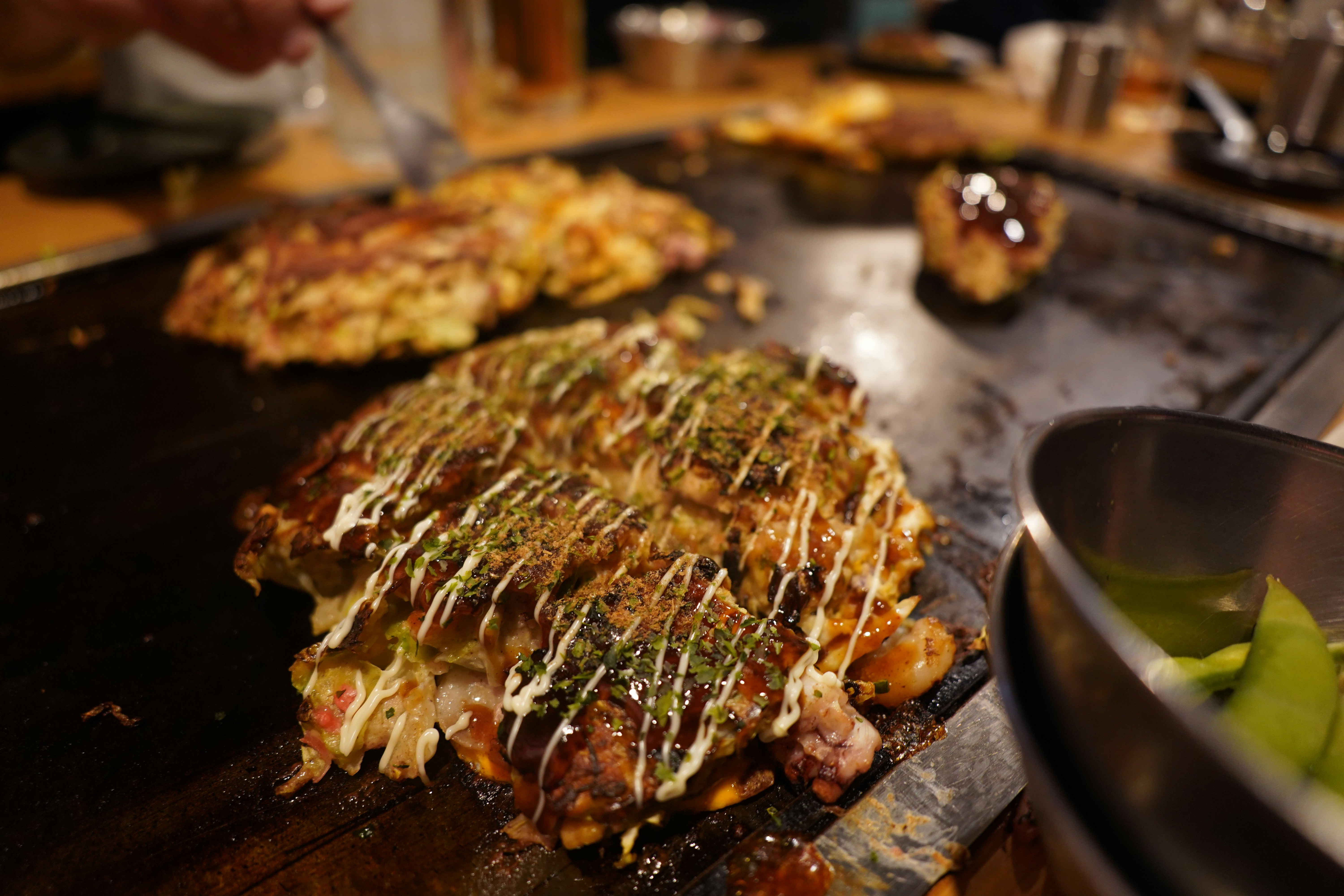 Griddle · Osaka & Hiroshima Classic
Okonomiyaki (お好み焼き)
Its name literally means "grilled as you like it" — there's no fixed recipe, just shredded cabbage, batter, and whatever topping the cook fancies.
Shredded cabbage is folded into a savory batter with a topping of choice — usually pork belly or seafood — cooked on a hot iron griddle, then finished with okonomiyaki sauce, mayonnaise…
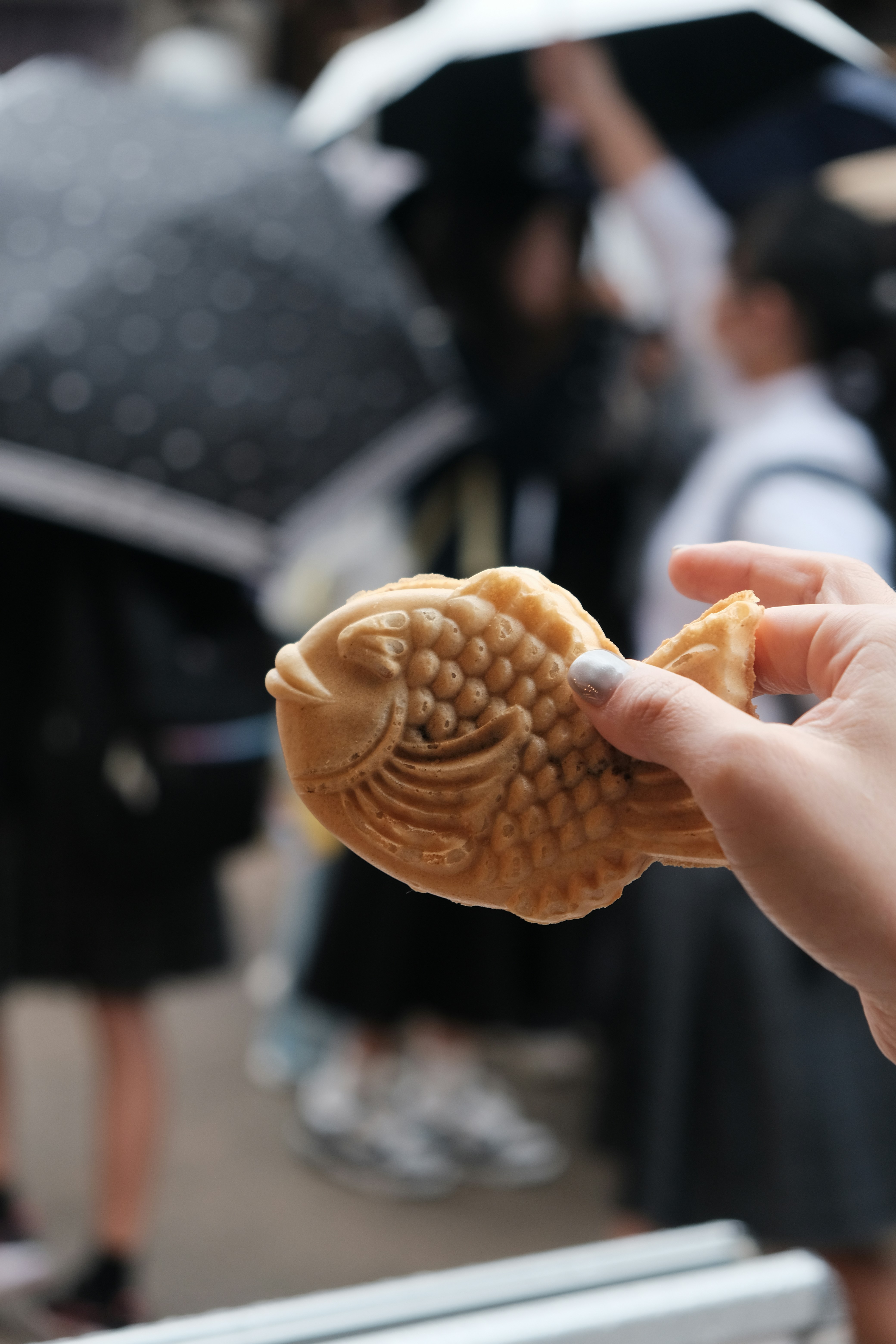 Dessert · Fish-Shaped Cake
Taiyaki (たい焼き)
Taiyaki was invented in 1909 as a cheaper spin-off of a round waffle cake — bakers shaped it like a sea bream, a fish tied to good fortune, so…
A waffle-like batter is poured into a heavy, fish-shaped iron mold, filled with a scoop of sweet red bean paste (or custard, chocolate, or sweet potato), then the mold is clamped shut and…
Street food by region
8 regions of Japan with their own dishes.
Hokkaido street food
 Ramen Alley Original · Hokkaido Winter Broth
Sapporo Miso Ramen
It was invented after a customer at a small Sapporo shop supposedly asked the owner to put noodles straight into his bowl of miso soup, kicking off…
Thick, wavy egg noodles bred specifically to stand up to a heavy broth are served in a rich pork-and-miso soup, often topped with corn, butter, bean sprouts and ground pork — a bowl built…
 Beer Garden Grill · Mutton on a Dome
Jingisukan (Genghis Khan Grilled Mutton)
The dome-shaped cast iron grill it's cooked on is shaped to resemble a Mongolian soldier's helmet — the name and imagery were adopted in Japan with…
Sliced mutton and lamb are grilled at the table on a convex iron dome, the rendered fat basting a ring of bean sprouts, onion and cabbage piled around the rim, everything dipped in a…
 Kushiro Original · Bone-In Fried Chicken
Zangi
The name comes from the Chinese word for fried chicken, zhájī — the Kushiro shop that coined it inserted an extra "n" sound in the middle, borrowed…
A whole chicken is hacked into large bone-in pieces, marinated in soy sauce, sake, garlic and ginger, then deep-fried to a dark, heavily seasoned crust and served with a dipping sauce…
 Dairy Farm Stand · Milk Soft Serve
Hokkaido Soft Cream
Hokkaido produces more than half of all the raw milk in Japan, and its soft serve is so much higher in butterfat that a cone here tastes noticeably…
A dense, high-butterfat soft serve made straight from Hokkaido's own dairies is sold from farm stands and roadside stops across the island, often folded with local specialty flavors like…
🌽
Odori Park Wagons · Soy-Glazed Corn
Yaki Tokibi (Sapporo Grilled Corn)
Tokibi is simply the Hokkaido dialect word for corn, so the carts in Sapporo's Odori Park are known as tokibi wagons.
Cobs of Hokkaido-grown corn are grilled until charred and brushed with a soy-based glaze, then handed over whole to eat standing in the park; the same carts also sell boiled corn and…
 Potato Mochi · Pioneer Food
Imomochi (Potato Rice Cakes)
Despite the name there is no rice in it: settlers made it as a mochi substitute because rice was hard to grow in early Hokkaido.
Steamed potatoes are mashed with potato starch, shaped into patties and pan-fried until crisp outside and chewy inside, usually finished with a sweet soy glaze, butter or melted cheese…
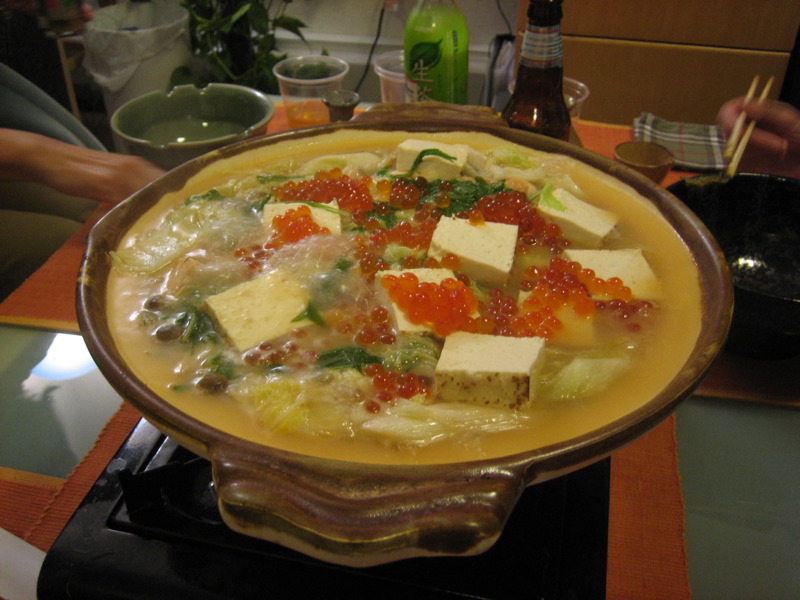 Ishikari River Classic · Salmon Miso Hot Pot
Ishikari Nabe
The traditional finishing touch is a pinch of sansho pepper, whose citrusy tingle cuts through the richness of the salmon and miso.
Fresh salmon chunks and bones are simmered with cabbage, daikon, potato, leek and tofu in a miso-flavored broth, traditionally finished with a sprinkle of sansho pepper; some cooks add a…
Kansai street food
 Shinsekai Classic · No Double-Dipping Skewers
Kushikatsu
The communal sauce trough at the table comes with one hard rule — one dip per skewer, no matter how much sauce is left on the stick — and regulars…
Bite-sized cuts of meat, seafood and vegetables are skewered on bamboo, coated in a thin layer of breadcrumbs and deep-fried, then dipped once each into a shared tonkatsu-style sauce and…
 Department Store Snack · Pressed Squid Pancake
Ikayaki (Osaka-Style Grilled Squid)
Outside Osaka, ikayaki usually means a whole squid grilled on a stick at festival stalls; Osaka's pressed pancake is a different snack that shares…
Chopped squid is mixed into a thin flour batter and pressed between two scorching iron plates for about a minute, cooking into a thin, chewy pancake that's brushed with sauce and folded in…
 Osaka Original · Green Onion Griddle Cake
Negiyaki
Negiyaki is traditionally eaten with soy sauce and a squeeze of lemon rather than okonomiyaki sauce, so the green onion's sweetness isn't buried…
A thin batter loaded with a heap of sliced green onion instead of cabbage is grilled on a teppan into a lacy, light pancake, then finished with soy sauce or a dashi-soy dip rather than the…
 Kyoto Souvenir Sweet · Cinnamon Rice Cake
Yatsuhashi
It started as a stiff, cracker-like baked rice wafer — the soft, folded raw version tourists eat by the box today only became the norm after mass…
Rice flour, sugar and cinnamon are worked into a dough, either baked thin and crisp into a curved cracker or left soft and folded raw ("nama yatsuhashi") around a dab of sweet red bean…
 Shinsekai Standby · Miso-Stewed Tendon
Doteyaki (Miso-Stewed Beef Tendon)
Dote means embankment: the name comes from the way miso is banked up around the edge of the pot like a riverbank.
Beef tendon and konnyaku are simmered for hours in sweet miso and mirin until soft, then served in small cheap portions at the counters of Osaka's kushikatsu joints and standing bars.
🥟
Kobe Chinatown · Steamed Pork Buns
Butaman (Kobe Pork Buns)
Roshoki, a shop in Kobe's Nankinmachi founded in 1915, calls itself the birthplace of the butaman, Japan's pork bun.
Small steamed buns stuffed with seasoned minced pork are sold hot from steamers at takeaway counters in Nankinmachi, Kobe's Chinatown, and eaten on the street.
 Akashi Original · Dashi-Dipped Octopus Dumplings
Akashiyaki
It's widely considered takoyaki's ancestor, but instead of a sweet brown sauce, these egg-rich dumplings get dunked whole into a hot bonito dashi…
Small round dumplings made from an egg-heavy batter studded with diced octopus are cooked in a special copper mold until barely set, then dipped into a hot dashi broth rather than topped…
Kanto street food
 Tsukishima Specialty · Runny Griddle Batter
Monjayaki
The batter is so watery it can't hold a pancake shape at all — cooks scrape it into a crispy ring on the griddle and eat straight off the hotplate…
A dashi-heavy, almost liquid batter mixed with cabbage and other fillings is poured onto a hot teppan, where it spreads thin and is scraped and pressed into a crackling crust, eaten bit by…
 Asakusa Souvenir · Doll-Shaped Cake
Ningyo-yaki
When it was invented in the early 1900s at a confectioner in Tokyo's Ningyocho district, ningyo-yaki was molded in the shape of the Seven Lucky…
A light castella-style batter of flour, egg and sugar is baked in individual cast-iron molds shaped like little figures, lanterns or temple pagodas, then filled with sweet red bean paste…
 Ameyoko Market Staple · Fried Meat Patty
Menchi Katsu
One popular story credits Ginza's Western-style restaurant Rengatei, opened in 1895, with the first menchi katsu, though its origin is disputed; it…
Ground meat mixed with onion and breadcrumbs is shaped into a flat patty, breaded and deep-fried until deeply crisp, then handed over on its own or tucked into a bun as a hot, walk-and-eat…
 Edo Fishermen's Bowl · Clam Rice
Fukagawa-meshi
There are two classic styles: the fishermen's original bukkake, clams in miso broth poured over rice, and a later takikomi version with the rice…
Asari clams are simmered with green onion, and sometimes tofu or fried tofu, in a miso-seasoned broth and poured over a bowl of rice, or the rice itself is cooked in the clam broth and…
🥟
Tochigi's Dumpling City · Takeaway Trays
Utsunomiya Gyoza
In 1990 a study group of city employees noticed Utsunomiya households topped the national gyoza spending figures and turned that statistic into a…
Pan-fried and boiled pork-and-vegetable dumplings served fast and cheap at small counter shops across Utsunomiya, many with takeaway windows, and at stalls during the city's annual gyoza…
 Enoshima Approach · Whole-Octopus Cracker
Tako Senbei (Enoshima Octopus Cracker)
Two or three whole small octopuses are flattened into each cracker by a hot press, so their outlines show clearly in the finished senbei.
Octopus is laid on thin cracker batter and squashed flat in a heavy heated iron press, then handed over crisp and hot to eat while walking the shopping street up to Enoshima Shrine.
🍣
Edo Bay Origin · Hand-Pressed Fast Food
Edomae Nigirizushi
Sushi began as street food eaten standing at a stall counter — the whole point of pressing rice and fish by hand was to skip the days-long…
Fresh Tokyo Bay fish is pressed by hand onto a small mound of vinegared rice and handed over two pieces at a time, built to be eaten on the spot rather than carried home.
Kyushu street food
 Yatai Row · Milky Pork Bone Broth
Hakata Tonkotsu Ramen
The broth's signature cloudy-white color was a mistake — at a Kurume ramen stall in 1947, the pork bones were accidentally left boiling on high heat…
Pork bones are boiled for hours until the broth turns thick, milky-white and intensely rich, ladled over ultra-thin noodles bred specifically to cook fast, topped simply with chashu pork…
 Hakata Izakaya Hot Pot · Beef Offal
Motsunabe
Offal in Japan is called 'horumon', and a popular folk etymology links it to Osaka dialect 'hōru mon', things you throw away, though the word more…
Beef or pork offal is simmered at the table in a shallow pot with a wall of garlic chives, cabbage and a soy or miso broth, traditionally finished by tipping in noodles or rice to soak up…
 Fukuoka Signature · Spicy Cod Roe
Karashi Mentaiko
Kawahara never patented or trademarked his karashi mentaiko recipe and shared it freely with competitors, which is why Fukuoka now has well over a…
Salted pollock roe sacs are cured in a chili-and-seasoning marinade until firm and deep red, then sliced open and eaten raw over rice, folded into pasta, or grilled — sold whole by weight…
 Oita Soul Food · Battered Fried Chicken
Toriten
Oita is also a karaage heartland, with the city of Nakatsu promoting itself as Japan's karaage capital, so one prefecture is home to two rival…
Boneless chicken pieces are marinated in soy sauce, sake and garlic, dipped in a thin tempura batter and deep-fried, then served with a ponzu dipping sauce spiked with hot mustard rather…
 Navy Town Burger · Made to Order
Sasebo Burger
There is no single recipe: each of the roughly 20 shops the city certifies as serving authentic Sasebo burgers makes its own version with its own…
Big, made-to-order hamburgers sold from burger stands and small shops across Sasebo, usually wrapped in paper for eating on the go.
 Nagasaki Chinatown · Braised Pork Bun
Kakuni Manju (Braised Pork Belly Bun)
The filling descends from Chinese dongpo pork, which reached Japan through Nagasaki, the port that kept trading with China during the Edo-period…
A thick slab of pork belly slow-braised in soy sauce, sugar and mirin is folded into a soft steamed bun, sold from bamboo steamers in Nagasaki's Chinatown and eaten on the street.
 Nagasaki Chinatown Original · Pork & Seafood Noodle Bowl
Nagasaki Champon
The noodles are never boiled separately — they're simmered directly in the pork-and-seafood broth, so the bowl thickens as the starch cooks right…
Thick wheat noodles are simmered together with stir-fried pork, squid, prawns, fish cake and vegetables in a milky pork-and-seafood broth, arriving as a single hearty one-bowl meal.
Okinawa street food
 Naha Noodle Shop · Wheat Noodle, Not Buckwheat
Okinawa Soba
Japan's own Fair Trade Commission tried to force a rename in 1976, ruling that "soba" legally requires buckwheat flour and Okinawa's noodles are…
Thick, springy wheat noodles closer in texture to ramen than to mainland buckwheat soba are served in a pork-and-bonito broth, topped with a slab of stewed pork rib or belly, a fishcake…
 Kin Town Original · Tex-Mex on Rice
Taco Rice
It was invented in 1984 specifically for American servicemen stationed at the nearby Camp Hansen Marine base, by swapping the taco shell for a bowl…
Seasoned ground beef, melted cheese, shredded lettuce and diced tomato are piled over a bowl of plain white rice and finished with salsa or hot sauce, eaten with a spoon rather than folded…
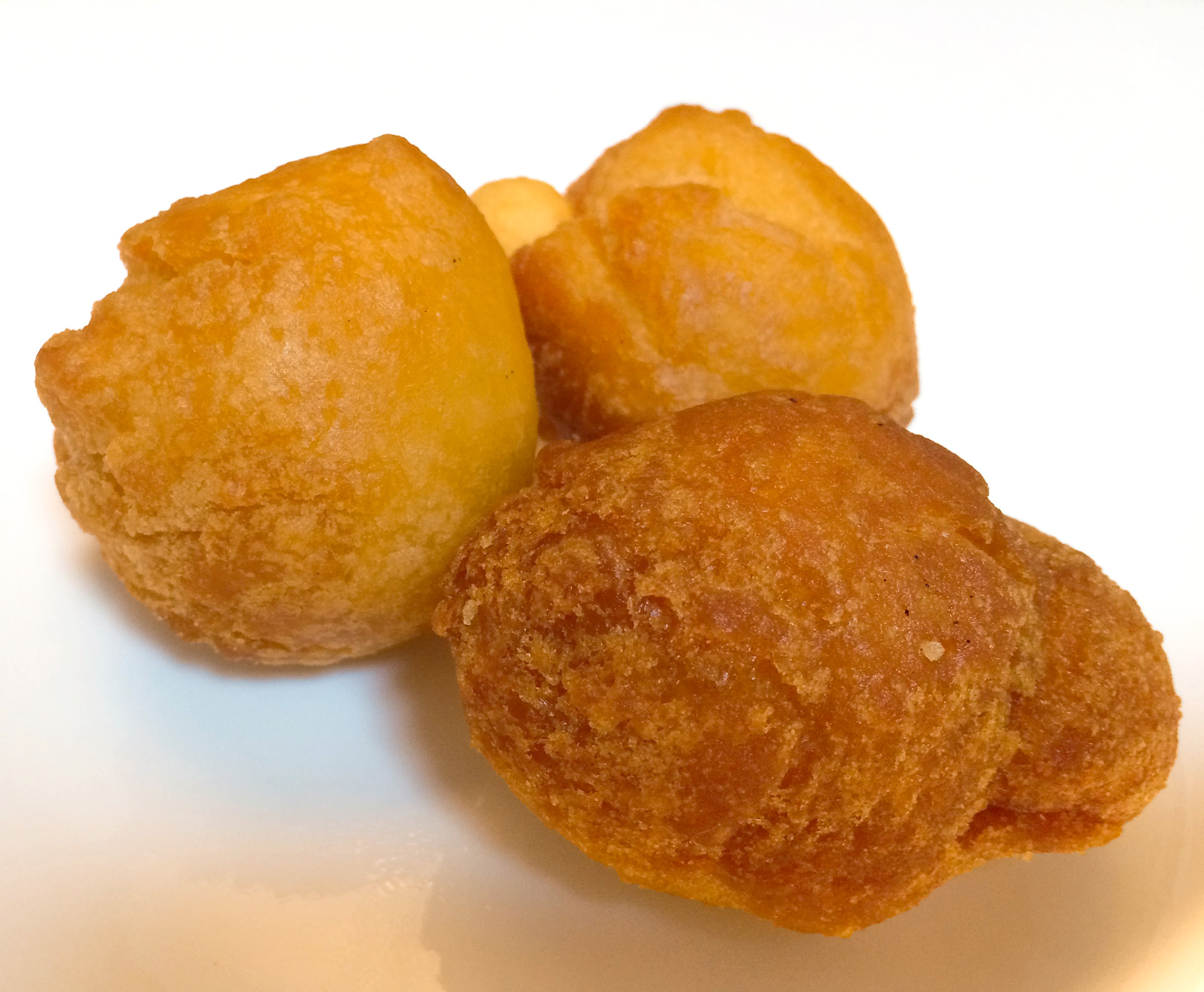 Ryukyu Court Sweet · Cracked Sugar Doughnut
Sata Andagi
Its name literally just means 'fried sugar' in Okinawan (sata = sugar, anda = oil, agi = fry), and the split that opens up as it fries is seen as a…
A stiff, only lightly sweetened dough of flour, egg and sugar is rolled into a ball and deep-fried until one side splits open into a golden, tulip-like crack, producing a dense, slightly…
 Ryukyu Royal Cuisine · Braised Pork Belly
Rafute
It's a direct descendant of a famous Chinese dish, Dongpo pork, adapted at the Ryukyu Kingdom's royal court by swapping in local awamori liquor and…
Thick-cut pork belly is simmered low and slow in awamori (Okinawan distilled spirit), soy sauce and dark brown sugar until the fat turns soft enough to cut with chopsticks, served in…
 Coastal Farm Delicacy · Green Caviar Seaweed
Umi-budo (Sea Grapes)
Each little sphere on the strand pops between your teeth like caviar, releasing a burst of seawater and mild ocean flavor — texture is the entire…
A branching green seaweed whose stems are lined with tiny grape-like beads is served raw and chilled, usually with a light vinegar-citrus dip, eaten as a side or appetizer at Okinawan…
 Luncheon Meat and Egg · Rice Ball Sandwich
Pork Tamago Onigiri
The pork in the name is canned luncheon meat, which Okinawans simply call pork.
A slice of fried luncheon meat and egg are sandwiched in rice and wrapped in nori, made fresh to order at takeaway shops such as the one near Naha's Makishi Public Market and eaten on the…
🍤
Thick Batter · Ojima Island Snack
Okinawan Tempura
Unlike mainland tempura, the batter is thick, fluffy and already seasoned, so it is eaten as a cheap snack without a dipping broth, often with just…
Fish, squid, mozuku seaweed and sweet potato fried in a heavy, fluffy batter and sold cheaply by the piece from tempura stands, most famously on Ojima Island in Nanjo City.
Chubu (Nagoya) street food
 Nagoya Ritual · Eel Rice, Three Ways
Hitsumabushi
The dish exists because of broken dishware — a Nagoya restaurant's delivery bowls kept shattering on the way back from customers, so the owner…
Grilled eel sliced over rice is served in a large wooden tub meant to be divided into portions: eaten plain first for the grilled aroma, then with condiments like scallion, wasabi and…
 Nagoya Bar Food · Double-Fried Wings
Tebasaki
The story goes that in 1963 a supplier delivered wings by mistake; wings were then used mostly for soup stock, so Furaibo's founder fried them and…
Chicken wings are double-fried until the skin turns shatteringly crisp, then tossed in a sweet-savory soy and mirin glaze and dusted heavily with black pepper and sesame seeds, eaten with…
 Yabaton Original · Red Miso Pork Cutlet
Misokatsu
Yabaton's story is that in 1947 a customer at its stall dipped a fried pork skewer into the neighboring pot of miso-simmered doteni stew; the…
A breaded, deep-fried pork cutlet is coated in a thick, dark, sweet-salty sauce built from Aichi's long-fermented Hatcho red miso, served sliced over rice or on its own with shredded…
 Nagoya Station Noodle · Flat Wide Udon
Kishimen
Nobody is sure where the name comes from: theories trace it to Imokawa's flat noodles, to pheasant (kiji) meat once used as a topping, or to noodles…
Very wide, flat wheat noodles — thinner than standard udon and quicker to cook — are served hot in a light soy-dashi broth topped with shaved bonito flakes, fried tofu, sliced fish cake…
 Mountain Skewer · Grilled Miso Rice
Gohei Mochi
It is said to have begun with lumberjacks in the Kiso area who pressed rice onto scraps of timber and grilled it over a bonfire with miso.
Pounded non-glutinous rice is moulded onto a flat wooden skewer, brushed with a sweet, nutty miso or soy sauce and grilled, sold at roadside stalls and old post towns in the mountains of…
 Nagano Dumpling · Nozawana Filling
Oyaki (Nagano Stuffed Dumplings)
Nagano listed oyaki as a prefectural intangible folk cultural property in 1983, when no other prefecture had yet designated a food that way.
Wheat or buckwheat dough wrapped around fillings such as stir-fried nozawana pickles, dried daikon, eggplant or pumpkin, then griddled and steamed or baked, sold hot from shops and stands…
 Nagoya Kissaten Culture · Red Bean Butter Toast
Ogura Toast
Nagoya lore credits a café called Mitsuba with creating it around 1921, after staff noticed students dunking buttered toast into zenzai, a sweet red…
Thick-cut slices of bread are toasted, spread with butter and topped or paired with sweetened azuki bean paste (ogura-an), typically served at old-school kissaten (coffee shops) as part of…
Tohoku street food
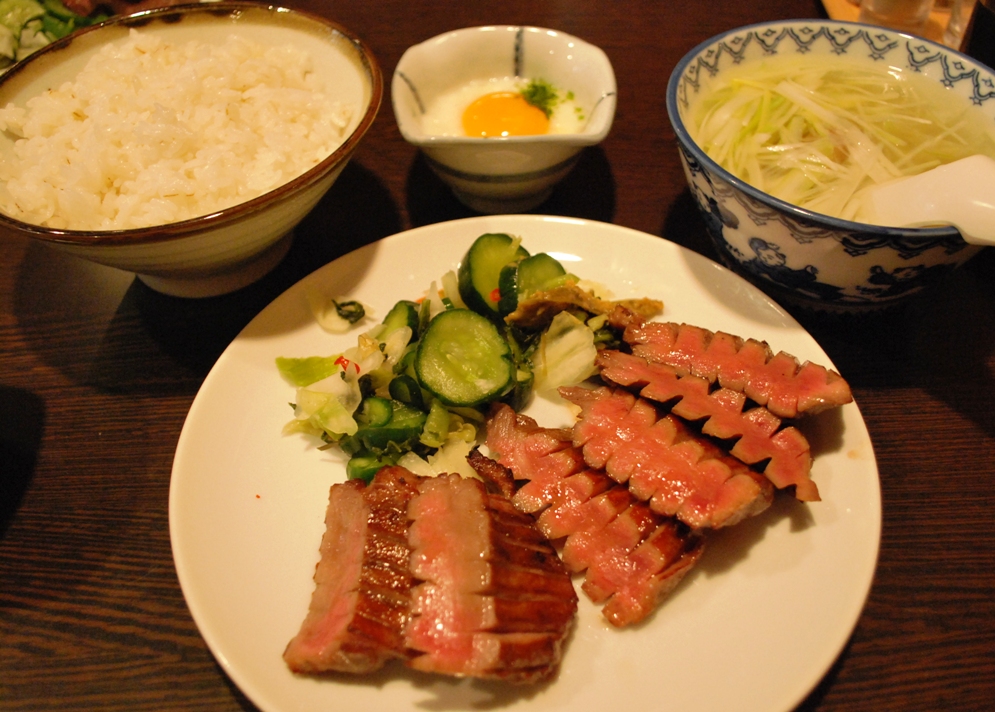 Sendai Postwar Original · Grilled Beef Tongue
Gyutan (Grilled Beef Tongue)
It exists because of postwar meat shortages — a Sendai restaurant owner started grilling beef tongue and oxtail, cuts American occupation forces…
Thick slices of salted beef tongue are grilled over charcoal until charred at the edges and tender inside, served alongside a bowl of barley rice, oxtail soup and pickles.
 Sendai Sweet · Mashed Edamame Rice Cake
Zunda Mochi
Zunda has moved well beyond mochi: Sendai now sells zunda milkshakes, and the green paste turns up in ice cream and cakes at the city's station.
Young soybeans (edamame) are boiled, shelled and mashed into a sweet, bright green paste, then spread thick over soft pounded rice cakes.
 Morioka Ritual · Endless Refill Soba
Wanko Soba
Servers keep dropping fresh bite-sized bowls of noodles into your bowl the instant you finish one — the only way to make them stop is to slam the…
Buckwheat soba noodles are served in small individual bowls, one mouthful at a time, with servers continuously refilling an eater's bowl until they physically cover it with the lid to…
 Akita Hunter's Pot · Pounded Rice Skewers
Kiritanpo Nabe
The rice isn't served as-is — it's pounded into a paste, molded around a cedar skewer and toasted over an open fire before it ever touches the hot…
Cooked rice is pounded until half-mashed, formed into cylinders around cedar skewers and lightly toasted, then sliced into chunks and simmered in a hot pot with local free-range chicken…
 Morioka Fusion · Cold Noodles With a Korean Root
Morioka Reimen
Shops let diners set the heat by how much kimchi goes in, from 'betsu-kara', with the kimchi served on the side, up to extra hot.
Chewy wheat-and-starch noodles are served in a cold, tangy beef-and-chicken broth with kimchi, sliced beef, cucumber and half a hard-boiled egg, often finished with a wedge of watermelon…
🍢
Yamagata Skewers · Before the Climb
Tama Konnyaku (Konjac Ball Skewers)
At Yamadera temple it is sold as chikara konnyaku, power konnyaku, to eat before climbing the 1,015 steps to the main hall.
Balls of konnyaku about 3 cm across are simmered in soy-based broth, skewered like dango and eaten hot with karashi mustard, sold at stalls around Yamadera, tourist spots and events across…
 Yamagata Snack · Rolled on Chopsticks
Dondon-yaki
The thin pancake is rolled around disposable chopsticks, so it comes with its own handle.
Flour batter is spread thin on a griddle, topped with fish sausage, nori and aonori, rolled onto chopsticks and brushed with sauce; sold at street stalls, shop counters and festivals in…
Chugoku & Shikoku street food
 Hiroshima Original · Layered, Not Mixed
Hiroshima-yaki
It grew from issen yoshoku, a prewar snack of thin batter folded over scallions sold cheaply to children; cabbage and noodles were added after the…
A thin crepe of batter is laid first, then piled with shredded cabbage, bean sprouts, pork belly, a portion of griddle-fried yakisoba noodles and a fried egg, stacked layer by layer on the…
 Kagawa Obsession · Chewy Wheat Noodles
Sanuki Udon
Kagawa has more udon shops per head than any other prefecture, and at its bare-bones self-serve shops customers warm their own noodles in hot water…
Firm, springy wheat noodles, traditionally kneaded underfoot for extra chew, are served either hot in a light soy-dashi broth or cold with a dipping sauce, often finished with grated…
 Miyajima Souvenir · Maple-Leaf Cake
Momiji Manju
A popular story links it to Prime Minister Ito Hirobumi, who is said to have joked that a teahouse girl's hand looked like a maple leaf good enough…
A castella-style sponge batter is baked in a small maple-leaf iron mold and filled with sweet red bean paste (or, in modern versions, custard, chocolate or cheese), sold warm from stalls…
 Port Town Bowl · Back-Fat Soy Broth
Onomichi Ramen
Chunks of chopped pork back-fat float on top and slowly melt into the broth as you eat, so the soup gets richer with every bite instead of cooling…
Flat, slightly curly noodles are served in a clear soy-sauce broth built on chicken stock and small local fish, topped with chunks of chopped pork back-fat that slowly render into the…
🍢
Ehime Original · Iron-Plate Skewers
Imabari Yakitori
The signature order is kawa, chicken skin pressed flat on the iron plate until it turns crisp and crackling.
Skewered chicken, pork or offal is cooked pressed flat against a hot iron plate, often under a heavy metal press, then brushed with a sweet-savory soy tare, producing a seared, slightly…
 Miyajima Shrine Street · Grilled Oysters
Yaki-gaki (Miyajima Grilled Oysters)
Hiroshima Prefecture farms around 60 percent of Japan's oysters, mostly on bamboo rafts in the Seto Inland Sea.
Oysters in the shell are set on a hot grill at the entrance of open-fronted shops along Miyajima's Omotesando shopping street, cooked until they open in their own juices and eaten on the…
 Ehime Fish Cake · Bones and All
Jakoten (Fried Fish Cake)
Local history credits Uwajima's first lord, Date Hidemune, with bringing a fish-cake maker from Sendai in 1615, which led to the first jakoten.
Small whole fish are ground with skin and bones, mixed with flour, egg and salt, shaped into flat ovals and deep-fried; sold hot by the piece at places like the Doya fish market in…
More street food in Asia
- Mongolia
- Thailand
- Vietnam
- India
- Indonesia
- South Korea
- China
- Philippines
- Malaysia
- Singapore
- Cambodia
- Laos
- Myanmar
- Sri Lanka
- Pakistan
- Bangladesh
- Nepal
- Bhutan
- Saudi Arabia
- United Arab Emirates
- Lebanon
- Israel
- Jordan
- Iran
- Kazakhstan
- Uzbekistan
- Maldives
- Brunei
Part of World of Street Food — 3443 dishes from 118 countries.
Photo credits.