Botswana Street Food
Botswana's street food clusters around bus ranks and market corners rather than curated food streets — fat cakes from a roadside pan, dried caterpillars sold by the sachet.
🐛 Dried mopane worms sold at Botswana roadside stalls pack roughly five times more iron, gram for gram, than beef.
25 street food dishes from Botswana, across 5 regions — what each one is, why it's made that way, and what to expect when you order it.
Signature street foods of Botswana
 Traditional Brew · Shake-Before-You-Drink Sorghum Beer
Chibuku (Bojalwa)
It's sold in a carton that looks like milk, and the packaging itself tells you to shake it — the sorghum and maize sediment settles to the bottom…
Chibuku is a commercial version of traditional Botswana sorghum beer (bojalwa), a thick, sourish, low-alcohol brew made from malted sorghum and maize. It's sold cheaply in waxed cartons or…
 Fried dough · Roadside staple
Magwinya (Vetkoek)
The Afrikaans name vetkoek literally means 'fat cake', which is also what many Batswana call them in English.
Magwinya, also called vetkoek or fat cakes, are balls of yeasted dough deep-fried until golden outside and fluffy inside. Vendors, often women working from bus ranks and market corners…
 Dried caterpillar · Wild-harvest protein
Phane (Mopane Worms)
Dried mopane worms are roughly half to two-thirds protein by weight, and the seasonal harvest supports a trade that runs across southern Africa.
Phane are the dried caterpillars of the mopane emperor moth, harvested from mopane trees, gutted, boiled, and sun-dried. Vendors sell small bags of the crunchy, earthy-tasting worms at…
 National Dish · Pounded Meat
Seswaa
It's traditionally pounded by men with a wooden pestle — the physical labor of shredding the meat is considered part of the dish's identity.
Beef (or goat or lamb) is slow-boiled in a three-legged iron pot until fall-apart tender, then pounded with a large wooden mortar and pestle until finely shredded and simply salted. Served…
 Staple Porridge · Sorghum
Bogobe (Sorghum Porridge)
A soured version made with fermented sorghum, called ting, gives bogobe a tangy flavour and is a favourite across Botswana.
Sorghum or millet flour is stirred steadily into boiling water until it thickens into a smooth, stiff porridge with a texture close to polenta. Market-corner food stalls and bus-rank cooks…
Street food by region
5 regions of Botswana with their own dishes.
Gaborone street food
 Funeral & Wedding Staple · Samp and Beans
Dikgobe (Samp and Beans)
Dikgobe is traditionally served with seswaa, the pounded beef that is Botswana's national dish, at both weddings and funerals.
Dried maize kernels (samp) are simmered for hours with sugar beans, peas, tomato, onion and chilli until they soften into a thick, stew-like porridge. It's cooked in large communal pots…
 Sunday Lunch · Setswana Chicken Stew
Koko ya Setswana (Setswana Chicken Stew)
Koko ya Setswana refers to the bird itself — the tougher free-range village chicken — which costs more than a supermarket broiler and needs long…
A free-range village chicken is cut up and simmered slowly with onion, salt and sometimes tomato until the tough meat turns tender and the broth thickens into gravy. In Gaborone it's a…
 Steamed Comfort Food · Dumplings
Matemekwane (Steamed Dumplings)
The dumplings have no filling at all — they're dropped as plain dough into simmering stew or water, puffing up and floating to the surface once…
A simple dough of flour, salt and baking powder is rolled into balls and simmered or steamed until light and spongy. Around Gaborone they're served alongside beef or chicken stew, soaking…
🫓
Stovetop Bread · Setswana Flatbread
Diphaphatha (Setswana Flatbread)
Diphaphatha is cooked entirely in a dry, covered pan with no oil or water added while it fries, making it closer to a griddle bread than a fried one.
A soft yeasted dough is shaped into flat rounds and cooked slowly in a covered pan until golden and puffed. Sold warm from breakfast tables and tuck-shops around Gaborone, it's torn by…
Francistown street food
 4,000-Year-Old Ferment · Sour Sorghum Porridge
Ting ya Mabele (Fermented Sorghum Porridge)
Ting's tang comes from wild lactic-acid fermentation of sorghum meal left to sour for two to three days before it's ever cooked — the same bacterial…
Sorghum meal is soaked and left to ferment for a couple of days, then cooked into a thick, mildly sour porridge. A Tswana staple eaten across Botswana, including around Francistown, it's…
 Kalanga Harvest Dish · Melon & Sour Milk Porridge
Bogobe jwa Lerotse (Melon Porridge, "Tophi")
The Kalanga name for this dish, tophi, is a completely different word from the Setswana bogobe jwa lerotse for what is essentially the same porridge…
Sorghum meal is cooked with pieces of lerotse — an indigenous melon that tastes more like cucumber than watermelon when raw — and soured milk, stirred with a wooden whisk called a lehetho…
 Market Butchery Classic · Tripe & Offal
Serobe (Tripe and Offal Stew)
Serobe is cooked from the intestines, tripe and other internal organs of a cow or goat, a dish born from a culture that lets almost nothing from a…
Tripe and intestines are cleaned, chopped and simmered for hours until tender, seasoned simply with salt, onion and sometimes chilli. It's a common sight at Francistown's Central Market…
 Post-Harvest Sweet · Watermelon & Maize
Umxhanxa (Watermelon and Dried Maize)
The dish is built around ijodo, a yellow-fleshed watermelon, cooked down with sugar and sun-dried maize kernels into a naturally sweet porridge with…
Yellow watermelon is stewed with sugar and rehydrated sun-dried maize until it breaks down into a soft, sweet dish. Traditionally prepared by Kalanga and Ndebele families around…
Maun street food
🌊
Delta Foraged Staple · Water Lily Bulb
Tswii (Water Lily Bulb)
Tswii, also called mwende, is harvested by hand from the beds of the Okavango Delta's channels, where the Bayei people have gathered the bulbs of…
The starchy bulbs of the water lily are dug from the shallows, cleaned and simmered over an open fire with fish, chicken or meat until soft. Around Maun and the Delta villages it's a…
 Delta Catch · Pan-Fried Bream
Okavango Bream
Bream is such a staple around Maun that stallholders serve it as an everyday lunch option, not a special-occasion treat, alongside beef and oxtail…
Bream caught fresh from the Delta's channels is scored, seasoned and marinated or pan-fried whole, sometimes finished with lemon and herbs. Local stallholders and lodges around Maun serve…
 Foraged After the Rains · Wild Amaranth Greens
Thepe (Wild Amaranth Greens)
Thepe only appears after the rains, so households traditionally dry and store the leaves to keep eating this morogo variety through the dry season.
The tender leaves and shoots of wild amaranth are picked, washed and stewed with onion, tomato and groundnuts into a soft, slightly bitter side dish. Around the Delta it's dished up next…
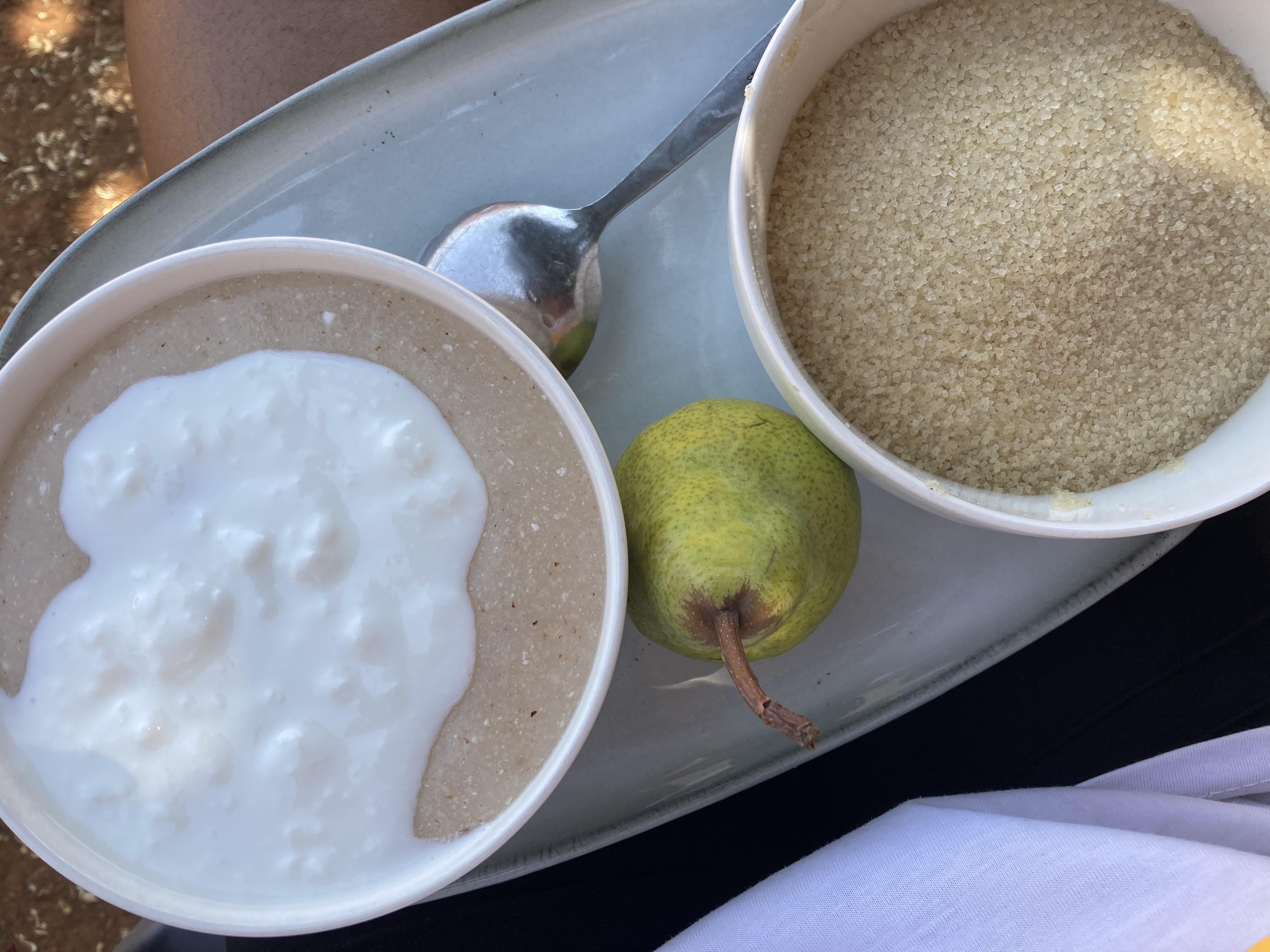 Breakfast Bowl · Sour Milk & Sorghum
Motogo wa Madila (Sorghum Porridge with Sour Milk)
Madila, the fermented milk stirred through this porridge, is made the same way pastoralist households have preserved milk for centuries — left to…
A thin, smooth sorghum porridge is cooked until soft, then finished with a generous swirl of madila, naturally soured milk, for a tangy breakfast bowl. It's a common start to the day at…
Delta Catch · Pan-Fried Bream
Okavango Bream
Bream is such a staple around Maun that stallholders serve it as an everyday lunch option, not a special-occasion treat, alongside beef and oxtail…
Bream caught fresh from the Delta's channels is scored, seasoned and marinated or pan-fried whole, sometimes finished with lemon and herbs. Local stallholders and lodges around Maun serve…
Foraged After the Rains · Wild Amaranth Greens
Thepe (Wild Amaranth Greens)
Thepe only appears after the rains, so households traditionally dry and store the leaves to keep eating this morogo variety through the dry season.
The tender leaves and shoots of wild amaranth are picked, washed and stewed with onion, tomato and groundnuts into a soft, slightly bitter side dish. Around the Delta it's dished up next…
Breakfast Bowl · Sour Milk & Sorghum
Motogo wa Madila (Sorghum Porridge with Sour Milk)
Madila, the fermented milk stirred through this porridge, is made the same way pastoralist households have preserved milk for centuries — left to…
A thin, smooth sorghum porridge is cooked until soft, then finished with a generous swirl of madila, naturally soured milk, for a tangy breakfast bowl. It's a common start to the day at…
Kasane street food
🐠
Riverside Signature · Sesame-Crusted Bream
Chobe Bream
'Bream' on Chobe menus usually means a tilapia species such as threespot or greenhead tilapia, both native to the Chobe-Zambezi river system.
Fillets of bream are coated in sesame seeds and pan-fried until crisp, then plated with pap and a spicy chakalaka relish. It's become the go-to fish dish at lodges and restaurants along…
🎣
Angler's Catch · Yellow-Belly Bream
Nembwe (Grilled Yellow-Belly Bream)
Unlike the plant-eating tilapia it resembles, nembwe is a predatory bream that hunts small fish, crabs and worms in the Chobe's channels, giving it…
Freshly caught nembwe, a hard-fighting predatory bream from the Chobe River's channels, is cleaned and grilled over coals at fishing camps around Kasane, usually the same day it's caught…
🍖
Three-Legged Pot · Game Meat Stew
Impala Potjie
A potjie is traditionally left unstirred while it cooks — the layers of meat and vegetables are meant to steam together undisturbed for hours, and…
Impala and other venison from the game-rich land around Chobe National Park is browned and slow-cooked with onion, vegetables and stock in a round, cast-iron three-legged pot over an open…
🍲
Slow-Braised Classic · Oxtail Stew
Mogatla (Oxtail Stew)
Mogatla takes its name directly from the Setswana word for tail, and the dish is prized precisely for the gelatinous richness that only slow-cooked…
Oxtail is browned and then braised for hours with tomatoes, onion, garlic and bay leaves until the meat slips off the bone and the sauce turns thick and glossy. Around Kasane it's a hearty…
Ghanzi street food
 San Foraged Protein · Roasted Wild Bean
Morama Bean (Roasted Gemsbok Bean)
Morama beans are traditionally roasted by burying them directly in hot sand, a cooking method as old as the Kalahari foraging traditions of the San…
The large, protein-rich seeds of a wild desert legume are picked from pods on its sprawling vines, then roasted — often in hot sand — until they take on a flavour compared to cashew or…
 Cattle Country Classic · Dried, Cured Meat
Segwapa (Botswana Biltong)
Ghanzi's ranches on the Kalahari sandveld are among Botswana's main cattle country, part of the national herd whose beef is exported to the European…
Strips of beef or game meat, such as kudu, are rubbed with salt, vinegar and spices like coriander and black pepper, then air-dried until firm and intensely flavoured. Around Ghanzi's…
 Desert Delicacy · Wild Underground Fungus
Kalahari Truffle (!Nabas)
The San find these truffles by spotting hairline cracks the growing fungus pushes up through the sand, and they appear only in years with good rains.
Known to the San as !nabas and sometimes called 'sand potato', this desert truffle grows just beneath the surface of the Kalahari sand around Ghanzi and is dug up by hand once cracks in…
 Desert Survival Food · Wild Watermelon
Tsamma Melon
Tsamma melons are about 90% water, and in dry spells people and animals alike, from antelope to hyenas, eat them for moisture.
This wild, bitter-fleshed relative of the watermelon grows scattered across the sand around Ghanzi and ripens deepest into the dry season, exactly when surface water disappears. Its flesh…
More street food in Africa
- Morocco
- Nigeria
- Egypt
- South Africa
- Ethiopia
- Kenya
- Ghana
- Senegal
- Tunisia
- Algeria
- Tanzania
- Uganda
- Zimbabwe
- Cameroon
- Ivory Coast
- Mali
- Rwanda
- Zambia
- Mozambique
- Sudan
- Libya
- DR Congo
- Somalia
- Madagascar
- Namibia
Part of World of Street Food — 3443 dishes from 118 countries.
Photo credits.