Zimbabwe Street Food
Zimbabwean street food runs on charcoal smoke and quick hands — roasted maize, fried dough, and grilled meat sold fast and eaten faster at bus terminals and market corners.
🌽 In Zimbabwe, roasted maize sold hot off a roadside brazier is such a daily fixture that vendors simply follow the corn season — and the foot traffic.
25 street food dishes from Zimbabwe, across 5 regions — what each one is, why it's made that way, and what to expect when you order it.
Signature street foods of Zimbabwe
 Shake Shake · Traditional Sorghum Beer
Chibuku (Shake Shake)
You have to shake the carton before drinking it — the settled sorghum solids are exactly what gives the beer its thick, porridge-like body.
Chibuku is an opaque, thick beer brewed from sorghum and maize, sold unpasteurized in paper cartons or plastic containers so fermentation keeps going right up until you drink it. It's…
 Snack · Roasted corn
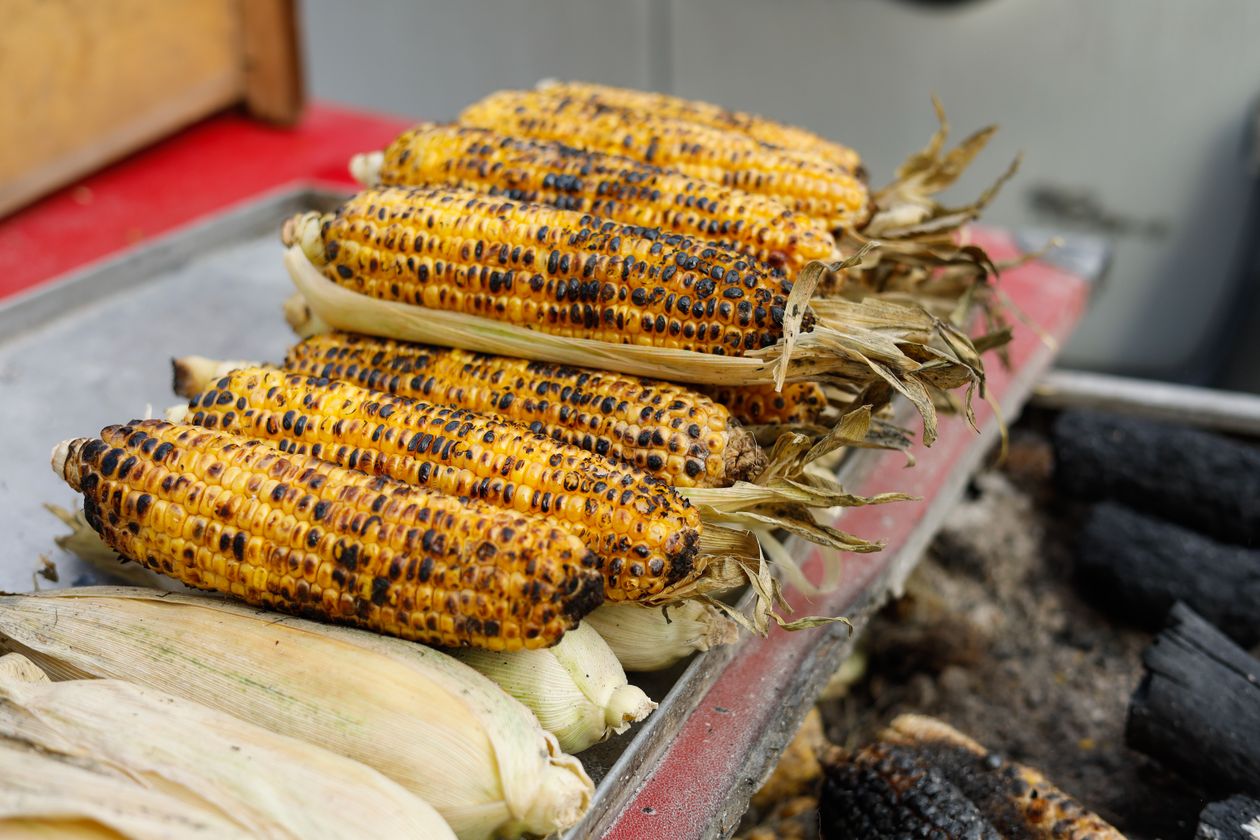
Roasted Maize (Mutandavare)
Vendors often sell the same fresh cobs two ways — roasted as mutandavare or boiled in salted water as mumhare.
Known locally as mutandavare or simply roasted mealies, this is corn on the cob grilled whole over open charcoal until the kernels char and caramelize slightly. Vendors sell it hot off the…
 Fried Dough · Fat cakes
Vetkoek
Its name literally means 'fat cake' — just flour, yeast, and hot oil turned into something completely addictive.
Vetkoek is a ball of yeasted dough deep-fried until the outside turns crisp and golden while the inside stays soft and fluffy. Street vendors sell it plain, dusted with sugar, or split…
 Snack · Roadside Delicacy
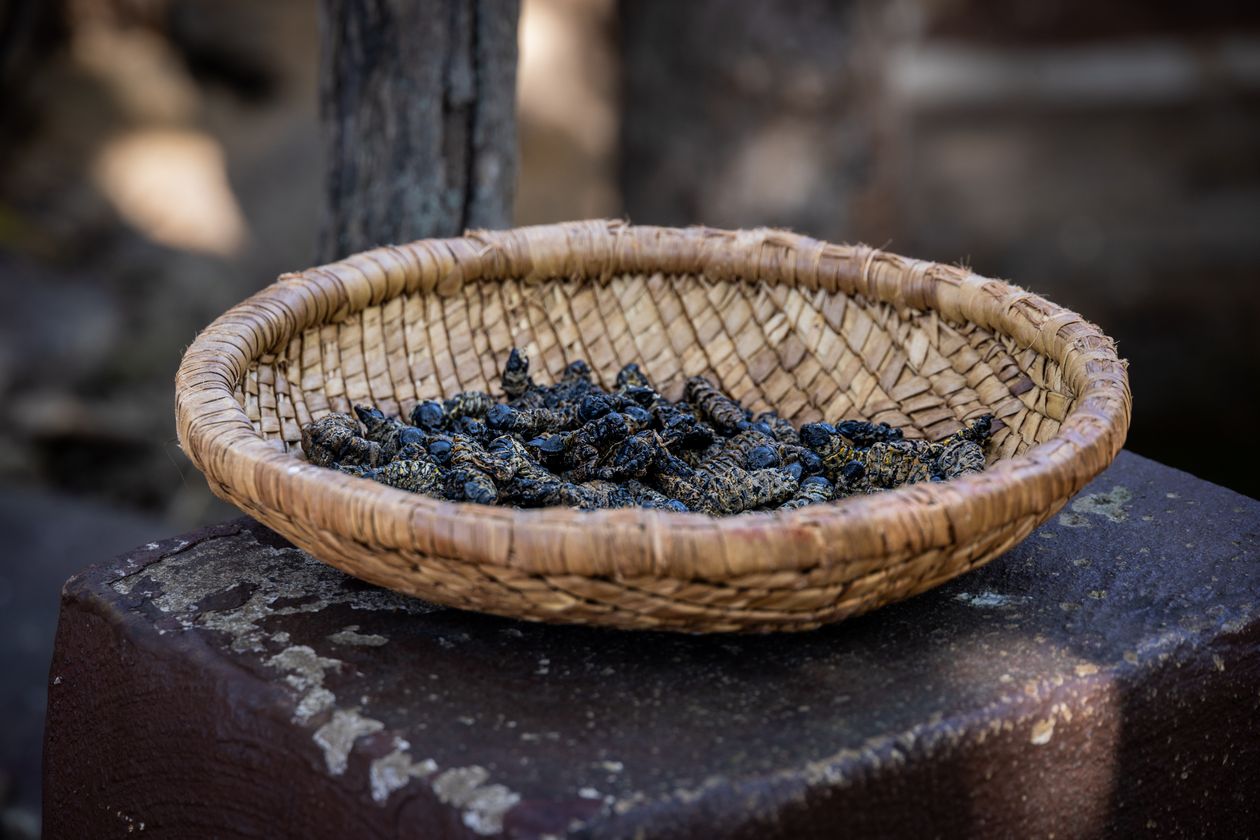
Madora (Mopane Worms)
Dried mopane worms are around 60% protein by dry weight, and the seasonal harvest is a significant source of cash income in rural southern Africa.
Madora are the dried caterpillars of the emperor moth, sold by the cupful in markets and at roadside stalls across Zimbabwe. Vendors rehydrate them and fry them with onion, tomato, and…
 Market Snack · Air-Dried Meat
Biltong
It predates refrigeration by centuries — the drying method was already used by indigenous herders long before Dutch settlers gave it its Afrikaans…
Strips of beef (or game meat) are marinated in vinegar, salt, coriander and black pepper, then hung to air-dry for several days until firm and deeply savory. Market stalls and roadside…
Street food by region
5 regions of Zimbabwe with their own dishes.
Harare street food
 Street Stew · Offal
Mazondo (Cow Trotters)
Cow trotters carry a folk reputation in Zimbabwe as a natural aphrodisiac, which keeps stalls selling it busy with mostly male customers.
Mazondo is a rich stew of cow (or pig) trotters, slow-simmered for hours with onion, tomato and garlic until the gelatinous meat falls off the bone. Vendors at Mbare Musika and other…
 Free-Range · Poultry
Road Runner Chicken
A road runner chicken can take up to six months to reach full size, several times longer than a broiler bird, which is part of why it now sells at a…
Named for the way these hardy indigenous chickens roam and scavenge instead of sitting caged, road runner chicken has leaner, firmer meat than broiler varieties. It's typically stewed in…
🌽
Boiled Grains · Snack
Mutakura
A single serving can combine four different crops — maize, peanuts, bambara nuts and cowpeas — making mutakura one of the most protein-dense street…
Mutakura mixes dried maize kernels, peanuts, bambara nuts (nyimo) and cowpeas, soaked overnight and then boiled together for hours until soft. Vendors sell it by the cupful as a filling…
🍊
Cordial · National Icon
Mazoe Orange Crush
The brand was actually founded in Bulawayo in 1930 by Arthur Sturgess, who named it for the Mazowe Valley oranges north of Harare after his wife…
This concentrated orange cordial, diluted with still or sparkling water, has been a Zimbabwean household staple since 1930. It's made using real orange juice sourced from citrus estates in…
Bulawayo street food
 Staple · Maize Porridge
Isitshwala
Isitshwala and Shona sadza are essentially the same maize porridge — the different name is one of the clearest everyday markers of Ndebele identity…
Isitshwala is the Ndebele name for the thick, stiff maize-meal porridge that anchors nearly every meal in Matabeleland. It's kneaded by hand into a smooth mass, then used to scoop up…
 Traditional Beer · Sorghum
Ingwebu (Sorghum Beer)
Bulawayo's city council has long run its own brewery, selling commercial sorghum beer under the Ingwebu name.
Ingwebu is the Ndebele name — it means 'froth' — for the cloudy, low-alcohol beer brewed from fermented maize and sorghum malt, known elsewhere in the region as umqombothi. It's brewed…
 Fermented Milk · Rural Staple
Amasi
Amasi ferments with no starter culture at all — just raw milk, a gourd or clay pot, and a few days of ambient warmth.
Amasi is raw cow's milk left to ferment naturally for a few days in a gourd, calabash or covered container until it thickens and turns pleasantly sour. It's eaten on its own, poured over…
🎃
Winter Dish · Maize & Pumpkin
Umxhanxa
Some versions swap in a yellow watermelon called ijodo instead of pumpkin — a seasonal variation particular to individual Ndebele and Kalanga…
Umxhanxa blends sun-dried maize kernels with cubes of pumpkin, boiled slowly for over two hours until the pumpkin melts into a soft, sweet base around the tender maize. It's a seasonal…
Mutare street food
 Highland Fish · Farmed Trout
Nyanga Trout
Trout aren't native to Zimbabwe — British settlers stocked them in the Eastern Highlands in the early 20th century, and Nyanga still has a trout…
The cool mountain streams and dams of Nyanga, in Zimbabwe's Eastern Highlands, are the country's best-known trout country. Lodges around Nyanga pan-fry or grill it fresh, and visitors can…
 Highland Fruit · Roadside Snack
Honde Valley Banana
The Honde Valley runs right up to the Mozambique border, and its banana plots share the valley with tea estates on the slopes above.
The fertile, high-rainfall Honde Valley below the Nyanga mountains is one of Zimbabwe's main banana-growing areas, alongside nearby Chimanimani and Chipinge. Bunches are sold from roadside…
🌰
Highland Nut · Export Crop
Chipinge Macadamia Nuts
Macadamia trees need years to mature, but a well-tended tree in Chipinge's climate can keep producing nuts for decades, making orchards…
Macadamia trees thrive in the misty, well-drained hills around Chipinge and Chimanimani in Zimbabwe's Eastern Highlands. Roasted, lightly salted macadamia nuts are sold by small growers…
🥬
Leafy Greens · Peanut Sauce
Muboora Unedovi
The dish uses the pumpkin's tender vine tips and leaves, not the fruit at all — a part of the plant many other cuisines simply discard.
Young pumpkin leaves and vine tips are stripped, chopped fine, and simmered with peanut butter, onion and tomato into a rich, slightly bitter-sweet relish. It's a common breakfast or side…
Victoria Falls street food
 Dried Fish · Lake Kariba
Kapenta (Matemba)
Because it's sun-dried on open racks, kapenta keeps for months without refrigeration, making it one of the most important protein sources for…
Kapenta are tiny freshwater sardines netted from Lake Kariba, then sun-dried on wooden racks so they keep without refrigeration. Cooks fry the dried fish with onion, tomato and groundnut…
 River Fish · Grilled
Zambezi Bream
"Bream" in Zimbabwe is a catch-all local name for several tilapia species — not the unrelated European bream that anglers elsewhere might picture.
Bream is netted from the Zambezi River and Lake Kariba, then scaled, seasoned and grilled or pan-fried whole, often finished with a squeeze of lemon and served with sadza or rice and a…
 Wild Fruit · Zambezi Valley
Masau
Masau is a jujube, Ziziphus mauritiana — the same species grown across South Asia as ber and sold in Indian markets.
Masau is a small, tart-sweet wild fruit that ripens on thorny trees across the Zambezi Valley in the dry season. Families and traders gather it to eat fresh, sun-dry it for later, or cook…
🍶
Palm Sap · Fermented Drink
Ilala Palm Wine
The same ilala palm that yields this wine also supplies the leaves used to weave the well-known Tonga baskets of Binga — one tree, two entire local…
Tapped from the trunk of the ilala (or 'malala') palm found across the Zambezi Valley and southern Matabeleland, the sweet sap ferments within hours into a mildly alcoholic, tangy palm…
Masvingo street food
 Pumpkin Porridge · Breakfast
Nhopi
Depending on the sweetness of the pumpkin used, nhopi can taste almost like a dessert, even though it's eaten as an everyday breakfast or snack…
Nhopi is a thick, almost custardy porridge made by boiling cubed pumpkin with mealie meal and stirring in peanut butter until smooth. It's sold at markets and made at home across the…
 Chewed Cane · Lowveld Snack
Sugar Cane
The Lowveld sugar industry began with Scottish settler Thomas Murray MacDougall, who dug an irrigation tunnel by hand in the 1920s to bring river…
Grown on the vast irrigated estates of Triangle and Hippo Valley in Masvingo province's low-lying Chiredzi district, raw sugar cane is cut into hand-length sticks, peeled with a knife, and…
 Bambara Nuts · Boiled Snack
Nyimo
Bambara nuts ripen underground like peanuts but come from West Africa, and are named after the Bambara people of Mali.
Nyimo, or bambara groundnuts, are boiled in their shells until tender and eaten by hand as a snack, or ground into a thick dip. They're sold boiled or roasted by vendors at rural markets…
🍚
Rice · Peanut Butter
Mupunga Unedovi
Unlike sadza, which is eaten with a relish on the side, the peanut butter here is cooked into the rice itself, so the dish can stand alone.
This simple dish combines long-grain rice, peanut butter and salt, simmered together until the rice takes on a rich, nutty sauce. It's a common lunch or dinner across Zimbabwe's…
More street food in Africa
- Morocco
- Nigeria
- Egypt
- South Africa
- Ethiopia
- Kenya
- Ghana
- Senegal
- Tunisia
- Algeria
- Tanzania
- Uganda
- Cameroon
- Ivory Coast
- Mali
- Rwanda
- Zambia
- Mozambique
- Sudan
- Libya
- DR Congo
- Somalia
- Madagascar
- Botswana
- Namibia
Part of World of Street Food — 3443 dishes from 118 countries.
Photo credits.